Prescription drug addiction affects 14.4 million Americans annually, yet only a fraction receive treatment. This research compilation provides authoritative, EEAT-compliant content covering the full landscape of prescription drug addiction — from clinical definitions and epidemiology to evidence-based natural remedies, safety precautions, and professional treatment pathways. Every claim is sourced from NIH, NIDA, SAMHSA, CDC, WHO, Mayo Clinic, Cleveland Clinic, and peer-reviewed literature.
What is prescription drug addiction
NIDA defines prescription drug misuse as “taking a medication in a manner or dose other than prescribed; taking someone else’s prescription, even if for a legitimate medical complaint such as pain; or taking a medication to feel euphoria.” NIDA 1. Addiction itself is “a chronic, relapsing disorder characterized by compulsive drug seeking, continued use despite harmful consequences, and long-lasting changes in the brain” 2 , 1 ; 3.
Mayo Clinic defines drug addiction (substance use disorder) as “a disease that affects a person’s brain and behavior and leads to an inability to control the use of a legal or illegal drug or medicine” 4 The DSM-5 replaced prior categories of “substance abuse” and “substance dependence” with a single diagnostic category — substance use disorder (SUD) — with three severity levels: mild, moderate, and severe {https://wyoleg.gov/InterimCommittee/2020/10-20201105Handoutfor6JtMHSACraig11.4.20.pdf Addiction corresponds to severe SUD 5 , 6 , 7.
How prescription drug addiction develops
Most addictive drugs affect the brain’s reward circuit by flooding it with dopamine, powerfully reinforcing drug-taking behavior. Three brain areas are central to addiction: (1) the basal ganglia (reward circuit), where repeated exposure diminishes sensitivity to pleasure; (2) the extended amygdala, which drives stressful feelings like anxiety during withdrawal; and (3) the prefrontal cortex, which governs decision-making and self-control and becomes impaired in addiction 7 , 7.
The pathway follows a progression: tolerance (needing higher doses for the same effect) 3 → dependence (neurons adapt so they function normally only in the presence of the drug) → addiction (compulsive, uncontrollable drug seeking despite harmful consequences) 6 , 8. (Source: 8.
Mayo Clinic explains the opioid-specific pathway: “Opioids trigger the release of endorphins… This creates a sense of well-being that is powerful but lasts only a short time. When an opioid dose wears off, you may find yourself wanting those good feelings back as soon as possible.” With repeated use, the body stops producing as many endorphins naturally 9. After only 5 days of taking an opioid, the chance of still taking opioids a year later increases significantly 9
Scope of the problem — United States
- 14.4 million people aged 12+ misused prescription psychotherapeutic drugs in the past year (2023), including 8.6 million who misused pain relievers, 4.7 million who misused tranquilizers/sedatives, and 3.9 million who misused stimulants 10
- 48.5 million people aged 12+ (17.1% of the population) had a substance use disorder in 2023 11
- Only 15.6% (7.1 million) of those with SUD received treatment; 84.4% did not National Association of Counties 12
- 105,007 drug overdose deaths in 2023; approximately 80,391 in 2024 — a 26.9% decline, CDC the largest drop in a decade 13
- 13,026 prescription opioid overdose deaths in 2023, down from peak of 17,029 in 2017 NIDA 14
- From 1999–2023, approximately 806,000 people died from opioid overdose 15
- Economic cost of the opioid epidemic: estimated $1.5 trillion in 2020 U.S. Congress Joint Economic Committee 16
- The CDC identifies three waves of the opioid crisis: Wave 1 (~1999, prescription opioids), Wave 2 (~2010, heroin), Wave 3 (~2013, synthetic opioids like fentanyl) CDC 15
Scope of the problem — Global
- 292 million people used drugs worldwide in 2022, a 20% increase over the past decade, UNODC including 60 million opioid users UNODC 17
- 0.6 million deaths annually are attributable to psychoactive drug use globally 18
- Only 1 in 11 people with drug use disorders globally receive treatment; treatment coverage ranges from less than 1% to 35% across countries 18 ; 17
Prescription drug addiction facts
| Symptoms by drug class {https://www.mayoclinic.org/diseases-conditions/prescription-drug-abuse/symptoms-causes/syc-20376813} , 19. |
|
| Causes |
|
| Types of commonly abused prescription drugs
|
|
| Age groups most affected
|
Prescription drug abuse is highest among teens and young adults 4
SUDs are most prevalent among young adults aged 18–25, with 27.1% having an SUD, yet this age group is least likely to receive treatment. 12. Prescription drug abuse in older adults is a growing problem, especially when combined with alcohol 21 and polypharmacy (Source: 21 Women are more likely to be prescribed opioids, given higher doses, and may be more likely to become dependent 4 , 9. |
| Risk factors
|
Family history of addiction; personal mental health disorders; peer pressure; lack of family involvement; early drug use; taking highly addictive drugs; easier access to prescription drugs; past or present addictions to other substances 4 , 4 ; 21. |
| Diagnosis — DSM-5 criteria
|
The DSM-5 lists 11 criteria for substance use disorder, 5 including: taking substance in larger amounts/longer than intended; unsuccessful efforts to cut down; excessive time obtaining/using/recovering; craving; failure in role obligations; continued use despite social problems; giving up activities; use in hazardous situations; continued use despite physical/psychological problems; tolerance; and withdrawal. Mild = 2–3 criteria; Moderate = 4–5; Severe (addiction) = 6+ 24 , 25 , 24.
Screening tools include: NIDA Quick Screen (under 5 minutes in primary care) 26 , 27 ; DAST-10 (10-item drug abuse screening) TargetHIV 28 ; CAGE-AID (4-question tool adapted to include drugs) 29. NIDA-Modified ASSIST 29. |
| Treatment and medications
|
Three FDA-approved medications for opioid use disorder (MAT): methadone (full opioid agonist), buprenorphine/naloxone (Suboxone — partial agonist), and naltrexone (Vivitrol — opioid antagonist) 30 , 31 Patients on MAT are 50% less likely to die of overdose 32. MAT decreases opioid use, overdose deaths, criminal activity, and infectious disease transmission 33 , 34 ; 35.
Behavioral therapies include cognitive-behavioral therapy (CBT), contingency management, 36 and motivational interviewing 37 , 1 , 36. |
| Relapse rates and other facts
|
Relapse rates for SUDs are 40–60%, comparable to other chronic diseases: 38 , 3 hypertension (50–70%), 39 asthma (50–70%), diabetes (30–50%). Relapse does not mean treatment failed — it signals the need for treatment adjustment 36 , 3. After 5 years of continuous recovery, relapse risk drops below 15% 38 , 36 Among those with SUD in 2023, 55.8% (27.2 million) also had a co-occurring mental illness 38 , 38. |
| Prevention
|
Key prevention strategies include: Prescription Drug Monitoring Programs (PDMPs); proper medication disposal through take-back programs; patient education about risks; CDC prescribing guidelines limiting opioid prescriptions to the shortest effective duration; discussing dangers with teens; keeping prescription drugs secured 4 21 ; 40. |
 Natural remedies for prescription drug addiction
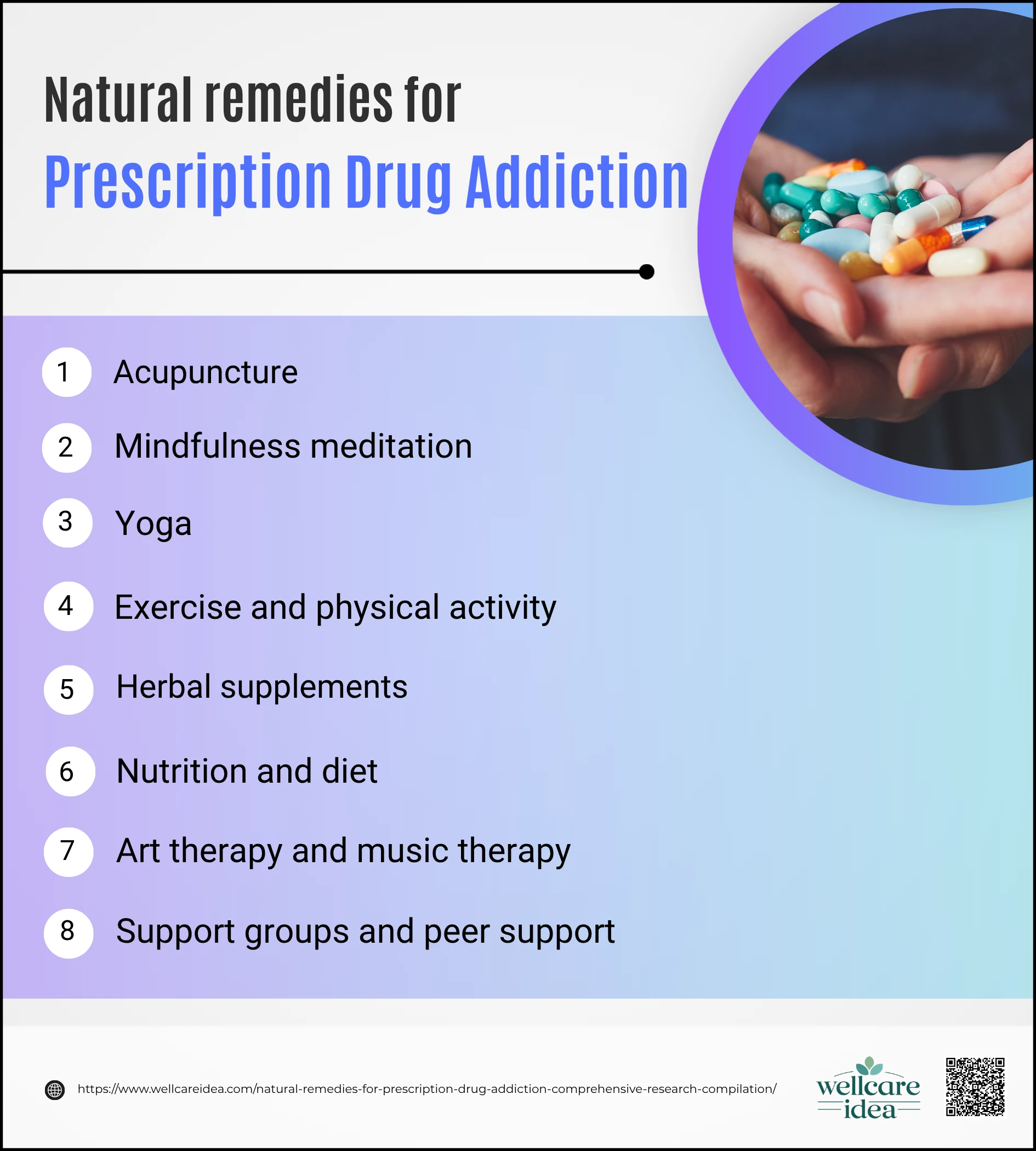
1. Acupuncture
NCCIH’s position: “There aren’t enough consistent data to support the use of acupuncture for subst ance use disorder treatment. However, some research suggests that acupuncture may be helpful in reducing withdrawal/craving and anxiety symptoms” 41 , 41. A 2016 systematic review of 41 studies (5,227 participants) found significant differences favoring acupuncture for craving and anxiety 42. A 2023 meta-analysis of 16 RCTs found acupuncture as adjunct therapy helped alleviate alcohol cravings and withdrawal severity 43 43 The NADA protocol (5 ear acupoints) is used in over 700 addiction treatment centers 44 , 45. Evidence quality remains limited 46.
2. Mindfulness meditation
NCCIH states: “Mindfulness-based interventions may help people reduce their use of substances such as alcohol, cigarettes, and opioids” NCCIH 41. Mindfulness-Based Relapse Prevention (MBRP) is an 8-session aftercare program developed at the University of Washington 47 A major RCT published in JAMA Psychiatry (N=286) found MBRP showed benefits at 12-month follow-up for reducing heavy drinking and drug use 48 A 2021 systematic review of 13 studies confirmed MBRP has “a significant positive impact on various substance use and clinical variables”. 49 MBRP works by decoupling habitual behavioral patterns from emotional/physiological triggers 50 51.
3. Yoga
NCCIH position: “Preliminary results of studies on yoga for substance use disorders have been positive, but larger, high-quality studies are needed” NCCIH 52. A 2021 systematic review of 8 RCTs found 7 of 8 studies showed significant positive outcomes when yoga was combined with pharmacologic treatment NCCIH 43 During yoga nidra meditation, a 65% increase in endogenous dopamine release was observed in the ventral striatum Frontiers (Source: 53 NCCIH is currently sponsoring research on yoga for chronic pain in people treated for opioid use disorder NCCIH 52.
4. Exercise and physical activity
Epidemiological studies show individuals meeting physical activity guidelines are less likely to use illicit drugs. Exercise stimulates natural release of dopamine, endorphins, serotonin, and norepinephrine, activating brain reward circuitry without creating dependency. Riverside Recovery of Tampa Preclinical evidence strongly supports exercise for reducing drug self-administration during acquisition, maintenance, and relapse phases 54 , 55. Exercise normalizes dopaminergic and glutamatergic transmissions and promotes neuroplasticity through BDNF-mediated epigenetic interactions Frontiers (Source: 56). Well-controlled clinical trials remain scarce but growing PubMed Central (Source: 55).
5. Herbal supplements
- Kudzu (Pueraria lobata): Studied for alcohol reduction; one study showed modest reductions in alcohol intake, but results have not been consistently replicated. No clear benefit established Pharmacy Times (Source: 57).
- Passionflower (Passiflora incarnata): A 14-day double-blind trial found passionflower + clonidine was superior to clonidine alone for emotional symptoms (anxiety, irritability, depression) during opioid withdrawal EBSCO (Source: 58 ; 59). Evidence: preliminary but promising.
- Ashwagandha (Withania somnifera): NCCIH states some preparations “may be effective for insomnia and stress” but evidence is unclear for anxiety. NCCIH Stress-reduction properties may indirectly support recovery, but no high-quality direct evidence for addiction treatment exists (Source: 60 ; 61).
- Milk thistle (Silybum marianum): NCCIH: “There isn’t enough high-quality evidence to allow definite conclusions about effects on health conditions.” Results for alcohol-related liver diseases have been “conflicting or too limited.” NCCIH Two NCCIH-funded studies found no benefit (Source: 62).
- N-Acetyl Cysteine (NAC): A 2017 meta-analysis (7 RCTs) found NAC significantly superior to placebo for craving symptoms PubMed {Source: https://pubmed.ncbi.nlm.nih.gov/28898494/}. A 2021 meta-analysis (16 trials) confirmed significant decreases in craving and depressive symptoms PubMed Central (Source: 63). However, a 2024 updated meta-analysis (9 trials, 623 participants) found NAC did NOT significantly outperform placebo, with very high heterogeneity (Source: 64 Evidence is mixed; NAC may be most effective for cocaine users (adults) and cannabis users (adolescents) (Source: 65).
6. Nutrition and diet
Substances substantially influence metabolism, appetite, and nutrient absorption. Common deficiencies in addiction include B vitamins, zinc, magnesium, omega-3 fatty acids, and amino acids 66 Less than 7% of treatment centers employ a nutritionist (Source: 67). Key recovery nutrients include: tyrosine and tryptophan (dopamine and serotonin precursors), omega-3 fatty acids (which reduced anger and anxiety in detoxification patients), NAC (which helps restore glutamate transporter levels) 68 (Source: 69 ; 68). The gut produces ~95% of the body’s serotonin 70 and substance abuse disrupts the gut microbiome, impairing mood regulation (Source: 66).
7. Art therapy and music therapy
A 2022 Cochrane systematic review (21 trials, 1,984 participants) found music therapy as adjunct to standard care led to moderate reductions in substance craving and increased motivation for treatment/change. Greater craving reduction was associated with music therapy lasting longer than a single session (Source: 43). A national survey found 36.8% of treatment programs offered art therapy and 14.7% offered music therapy (Source: 71).
8. Support groups and peer support
A 2020 Cochrane review found that when AA/12-step programs are subjected to the same scientific standards as other interventions, they perform at least equivalently and are “better at sustaining abstinence and remission over time” and “highly cost-effective” (Source: 72). SMART Recovery uses cognitive-behavioral and motivational techniques with over 3,000 meetings in 20+ countries. SAMHSA defines peer recovery support services as services designed and delivered by people in recovery, and all U.S. states now have peer certification standards (Source: 73.
Other complementary approaches
- Neurofeedback: A 2026 meta-analysis (17 RCTs, 662 participants) found EEG neurofeedback significantly alleviated addiction symptoms (Hedges’ g = 0.85, p<0.001) (Source: 74.
- Tai Chi/Qigong: A 2022 systematic review found these practices reduce anxiety and depression in SUD populations (Source: 75).
Precautions before using natural remedies
“Natural” does not mean “safe”
NCCIH explicitly warns: “‘Natural’ does not necessarily mean ‘safe.’ For example, the herbs comfrey and kava can cause serious harm to the liver” (Source: 76). All complementary approaches should be used alongside conventional medical care, never as replacements (Source: 77).
FDA does not approve supplements before marketing
Under the Dietary Supplement Health and Education Act (DSHEA) of 1994, “FDA does not have the authority to approve dietary supplements before they are marketed.” Manufacturers are responsible for evaluating safety and labeling; FDA can only act after products reach market (Source: 78). FDA has found over 1,060 tainted products marketed as dietary supplements containing hidden prescription drugs {Source: https://pmc.ncbi.nlm.nih.gov/articles/PMC6324457/} All structure/function claims must carry a disclaimer: “This statement has not been evaluated by the FDA. This product is not intended to diagnose, treat, cure, or prevent any disease” (Source: 78).
Dangerous drug interactions
St. John’s Wort has an “overall high risk of drug interaction” as a potent inducer of cytochrome P-450 enzymes (Source: 79). It can reduce methadone blood levels to 47% of original concentration, inducing withdrawal symptoms (Source: 80. It can reduce buprenorphine levels, making treatment less effective and triggering withdrawal (Source: 81). Mayo Clinic warns: “Don’t take St. John’s wort with methadone” (Source: 82).
Kava can interact with benzodiazepines, adding to CNS depressant effects. When combined with Xanax, kava has caused a “semicomatose state.” Kava components are hepatotoxic (Source: 83; 84).
Risks of replacing medical treatment
NIDA states: “Detoxification alone without subsequent treatment generally leads to resumption of drug use” NIDA and medical detox is “only the first stage of treatment” (Source: 36). Self-detox is “a leading cause of relapse and drug or alcohol-related overdose deaths.” Attempting to quit cold turkey is “unsafe, dangerous, and possibly life-threatening” 85 (Source: 86 NCCIH advises: “Tell your health care providers about any complementary health products or practices you use” (Source: 76).
When to seek professional help
Signs that natural remedies are insufficient
NIDA describes addiction as involving “intense and, at times, uncontrollable drug craving, along with compulsive drug seeking and use that persist even in the face of devastating consequences.” 87. Warning signs include: continued use despite harmful consequences, inability to stop despite wanting to, escalating use/tolerance, spending excessive time obtaining or using the substance, failing to meet work/school/home obligations, and giving up important activities 2).
Emergency signs of overdose
Opioid overdose signs: Blue/purple fingernails and lips, unresponsiveness, pinpoint pupils, slow/shallow/stopped breathing, snoring or gurgling sounds, cold/clammy skin, very slow or stopped heartbeat. Call 911 immediately 88. Naloxone (Narcan) “rapidly reverses an opioid overdose” and “can quickly restore normal breathing.” It works for 30–90 minutes, after which overdose symptoms may return — medical care is essential. Naloxone only works on opioid overdoses and has no effect on someone without opioids in their system 89.
Medically supervised detox is essential for certain substances
Supervised medical detox is the standard of care for withdrawal from opioids, benzodiazepines, and alcohol. Alcohol withdrawal can progress to seizures and delirium tremens with a fatality rate of up to 15% if untreated. Benzodiazepine withdrawal can cause severe or life-threatening symptoms requiring gradual tapering. Opioid withdrawal, while typically not life-threatening, is “intensely painful and debilitating” and “often leads to immediate relapse” 90 , 91). NIDA emphasizes: “No single addiction treatment is appropriate for all individuals” and effective treatment must attend to multiple needs 87.
Professional treatment resources
| Resource | Contact |
| SAMHSA National Helpline | 1-800-662-4357 (24/7, free, confidential) |
| SAMHSA Treatment Locator | findtreatment.gov |
| 988 Suicide & Crisis Lifeline | Call or text 988 |
| NIDA Drug Facts | nida.nih.gov |
| American Addiction Centers | 888-966-8152 |