
Everyone recognizes that familiar, undeniable burn spreading through the chest when things go wrong, but defining it clinically takes a bit more precision. In psychological terms, you experience this emotion as a distinct state of tension and hostility that usually arises when you face profound frustration, perceive a deep injustice, or suffer a real or imagined injury at the hands of someone else 1. While you might assume that feeling furious automatically leads to lashing out, medical experts emphasize that this internal emotional state is completely distinct from aggression, which is the actual behavior intended to cause harm 2.
Types of Anger
Taking a hard look at your own reactions will quickly reveal that you do not always express your frustration in exactly the same way. When you harness your intense feelings as a powerful, controlled motivator to enforce your personal boundaries and correct injustices, you are utilizing assertive anger, which is widely considered the most constructive and healthy manifestation of this emotion 3. Conversely, if you tend to avoid direct confrontation and instead express your fury through subtle sabotage, chronic procrastination, or veiled mockery, you are relying on a passive-aggressive style that often damages relationships without resolving the underlying issue 4.
Living with a constant, simmering undercurrent of resentment means you are likely dealing with chronic anger, an exhausting emotional baseline that can sometimes mimic the psychological loops of behavioral addiction 5. If your emotions frequently boil over into physical expression resulting in broken objects or altercations, you are crossing the boundary into behavioral anger, a highly destructive state that rarely yields positive outcomes 6. Furthermore, when you feel completely overloaded by daily stress and sensory input, your nervous system might simply give out, leading to overwhelmed anger that serves as a desperate psychological pressure valve rather than a malicious attack 7.
Causes of Anger
Pinpointing exactly what sets off your temper requires you to look far beyond the immediate annoyance standing right in front of you. Often, the true trigger involves a complex interaction between a stressful external event—like being aggressively cut off in traffic or facing a sudden job loss—and your own internal personality traits, such as an underlying sense of competitiveness or a fundamentally low tolerance for daily frustrations 8. When you feel that your fundamental expectations are being repeatedly violated, or you experience a sudden restriction of your personal autonomy, those feelings of deep vulnerability are frequently externalized as intense, defensive hostility 9.
Digging deeper into your psychological background often reveals hidden emotional landmines that have been buried for years. If you live with underlying mental health conditions, such as Attention-Deficit/Hyperactivity Disorder (ADHD), Post-Traumatic Stress Disorder (PTSD), or Borderline Personality Disorder, you face severe, ongoing compromises to your natural capacity for emotional regulation 10. Additionally, navigating modern society during periods of global instability, economic hardship, or widespread ideological debate creates a collective, low-grade anxiety that dramatically lowers your individual threshold for explosive outbursts 11.
Looking past your thoughts, you must also recognize that your physical biology heavily dictates how quickly you lose your cool. Structural alterations in your brain’s amygdala and natural variations in how your body metabolizes serotonin significantly determine whether you will react to a minor inconvenience with a calm shrug or a fiery tirade 12. There is even a substantial hereditary component at play, meaning that if your parents frequently exploded under pressure, they may have passed down a genetic predisposition that wires your nervous system to respond to stress with immediate aggression 13.
Section 3: Anger Facts
Wrapping your head around how this emotion operates requires breaking down the clinical facts into an easily digestible format. You can better understand your own psychological profile by reviewing the structured data points compiled by leading medical institutions and addiction organizations.
| Category | Facts |
| Symptoms |
|
| Causes | |
| Types of Anger |
|
| How does spread | |
| Caused of Anger | |
| Age Group | |
| You might be at a higher risk for exposure of this disease if you: |
|
| How doctors diagnose | |
| Remedies for Anger |
|
| Add other facts |
 Ways to Control Your Anger
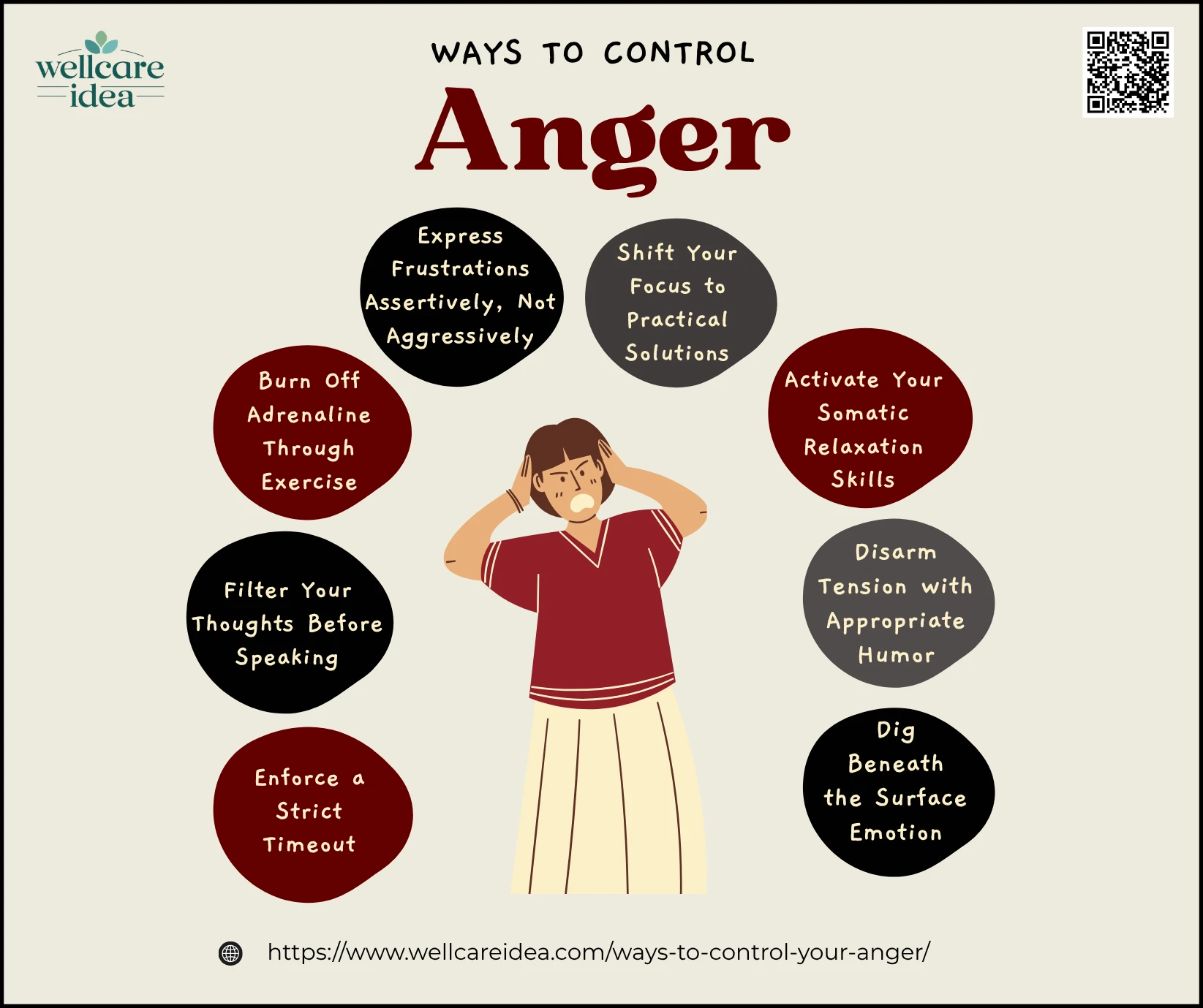
Grabbing the reins of your own emotional landscape requires you to move past passive reflection and start taking decisive, structured action. When you feel the familiar heat rising in your chest, you need a pre-planned toolkit of proven strategies to de-escalate the situation before it spirals out of your control. Here are highly effective, clinically supported methods you can implement to regain your composure:
1. Enforce a Strict Timeout
Stepping away from a heated conflict is not a sign of surrender; it is a vital neurobiological reset that you owe yourself. When you physically remove yourself from an escalating environment—even just by walking down the hall or stepping outside for a few minutes—you prevent your autonomic nervous system from reaching a critical, explosive threshold 35.
2. Filter Your Thoughts Before Speaking
Allowing your mouth to outpace your brain during a confrontation usually results in deeply regrettable, damaging statements that you cannot take back. By intentionally pausing to collect your thoughts and challenging your own hostile internal dialogue, you give the rational part of your brain a chance to override your primitive, reactive impulses 38.
3. Burn Off Adrenaline Through Exercise
Trapped emotional energy demands a physical release, and hitting the pavement is one of the most effective ways you can metabolize that excess stress. When you engage in brisk cardiovascular exercise, like running or cycling, you rapidly flush cortisol out of your system and stimulate the release of calming, mood-elevating endorphins 39.
4. Express Frustrations Assertively, Not Aggressively
Holding onto your grievances only poisons your own mind, so you must learn to articulate what is bothering you once your heart rate has returned to normal. You can effectively communicate your boundaries and needs by using calm, direct “I” statements, ensuring that you address the problem without resorting to character assassinations or attempts to control the other person 24.
5. Shift Your Focus to Practical Solutions
Fixating endlessly on the unfairness of a situation or the exact details of an insult will keep you locked in a toxic emotional loop. You can completely neutralize the emotional charge of an argument by redirecting your mental energy toward finding tangible, logistical compromises that actually solve the underlying daily frictions 19.
6. Activate Your Somatic Relaxation Skills
Commanding your body to calm down through deliberate physical actions will literally reverse the psychological experience of rage. You can immediately lower your heart rate and signal safety to your nervous system by practicing deep, diaphragmatic breathing, progressively relaxing your tense muscles, or quietly repeating a comforting word to yourself 40.
7. Disarm Tension with Appropriate Humor
Injecting a bit of well-timed levity into a standoff can shatter the unrealistic, grandiose expectations that usually fuel a temper tantrum. By finding the absurdity in the situation, you can quickly diffuse physiological tension; however, you must strictly avoid sarcasm, as that is just another form of passive aggression that will only make things worse 41.
8. Dig Beneath the Surface Emotion
Protecting your vulnerable feelings with a shield of hostility is a natural defense mechanism, but it prevents you from addressing your true pain. If you pause and honestly explore the primary feelings lurking beneath your rage, you will often uncover profound fear, acute jealousy, or deep-seated grief that actually requires your attention and healing 42.
Section 5: Precaution Before Use of Natural Remedies
Reaching for a bottle of botanical supplements might seem like a harmless, gentle way to take the edge off your irritability, but you must treat these remedies with serious medical respect. While clinical data shows that certain natural options can effectively lessen excitability and emotional distress, the lack of stringent quality regulation means that you can never be entirely sure of the purity or exact dosing in commercial products 43. Furthermore, you need to understand that the “natural” label does not automatically equate to inherent safety, as these active biological compounds can trigger severe, unexpected side effects in your body 44.
Mixing herbal interventions with your existing daily prescriptions opens the door to dangerous, sometimes life-threatening physiological interactions. If you decide to take chamomile for its calming properties while you are also on prescription blood thinners, you drastically increase your risk for severe internal bleeding 45. Additionally, if you rely on supplements like Valerian root or Passionflower to soothe your nervous system, you must be hyper-aware that they can induce profound dizziness and cognitive confusion, which becomes exceptionally hazardous if you combine them with alcohol or attempt to drive a vehicle 46.
Protecting your long-term organ health requires you to investigate the clinical warnings associated with specific holistic treatments before you ingest them. For instance, if you consider using Kava as a short-term strategy to manage your stress and hostility, you must know that federal health authorities have issued severe warnings linking it to devastating liver toxicity and organ damage 47. Lastly, if you are pregnant or currently breastfeeding, you must strictly avoid the vast majority of these herbal preparations, as there is a critical lack of long-term safety data regarding how they might disrupt fetal development or harm a nursing infant 48.
How Anger Spreads Through Your Environment
Catching a foul mood from a coworker or family member is not just a figure of speech; it is a measurable, biological phenomenon known as emotional contagion. When you stand face-to-face with someone who is seething with hostility, you subconsciously mimic their micro-expressions, aggressive posture, and vocal inflections, which sends immediate signals to your own brain to generate the exact same agitated emotional state 49. You do not even need to be in the same physical room to be infected by this negativity; reading text-based outbursts on digital forums or social media networks will rapidly elevate your own feelings of frustration, increase your verbosity, and make you much more likely to engage in disagreements online 23.
Watching this emotional virus spread within the walls of a family home reveals deeply concerning impacts on early childhood cognitive development. If you happen to be an over-reactive parent who frequently explodes when your limits are tested, your toddlers are meticulously observing and absorbing that harsh, emotionally charged environment 50. Consequently, those children are incredibly likely to develop elevated levels of “negative emotionality,” meaning they will model your aggressive problem-solving style by throwing severe temper tantrums and exhibiting long-term deficiencies in their own emotional self-regulation 51.
The Hidden Health Consequences and Addiction Links
Ignoring your explosive temper does far more than just damage your personal reputation; it systematically destroys your cardiovascular system from the inside out. Whenever you experience an intense, brief bout of hostility, your blood vessels severely lose their ability to dilate and contract properly, which creates the perfect precursor for the buildup of fatty deposits known as atherosclerosis 52. Over time, if you constantly flood your body with adrenaline and maintain a hostile baseline, you significantly elevate your overall mortality risk, making yourself highly susceptible to sudden heart failure and dangerous atrial fibrillation 53.
Navigating the turbulent waters of addiction becomes exponentially more difficult when you cannot regulate your daily emotional responses. Clinical data shows that if you use psychoactive substances, you are guaranteed to exhibit drastically higher trait anger scores than non-users, simply because chronic chemical dependency fundamentally damages the neural circuits responsible for your impulse control and executive judgment 54. When you are struggling to maintain your sobriety, the inability to process your frustrations safely becomes one of the most prominent triggers for a devastating relapse, which is why modern recovery programs now integrate intensive emotional management training right alongside traditional addiction treatments 55.
Professional Diagnosis and Clinical Therapies
Realizing that your emotional outbursts have spiraled beyond the scope of simple home remedies is the first step toward reclaiming your psychological stability. When you consult with a licensed mental health professional, they will evaluate whether your reactions align with the clinical criteria for Intermittent Explosive Disorder, looking specifically for a pattern of low-intensity aggressive episodes occurring twice a week, or catastrophic, property-damaging outbursts happening a few times a year 56. To get a precise measurement of your hostility, your clinician will likely have you complete the State-Trait Anger Expression Inventory-2, a diagnostic tool that perfectly identifies whether you tend to suppress your fury inwardly or unleash it outwardly onto others 57.
Sitting down in a therapist’s office gives you access to incredibly powerful, scientifically validated frameworks designed to rewire your brain’s reactive pathways. If you engage in Cognitive Behavioral Therapy, you will learn how to systematically identify and dismantle the distorted, catastrophic thoughts that fuel your rage, replacing them with rational problem-solving skills that vastly improve your clinical outcomes 58. Alternatively, if your dysregulation is particularly severe, you will benefit immensely from Dialectical Behavior Therapy, a modality that neuroimaging proves can actually increase gray matter volume in the areas of your brain responsible for emotional control and distress tolerance 34.