
Chances are, if you are reading this, you or someone you care about has become caught in the exhausting, frustrating cycle of relying on medication just to get a few hours of rest. Finding yourself dependent on sleeping pills is an incredibly common experience that usually starts with a simple, genuine need for relief from stress, a difficult life event, or a temporary bout of insomnia. Over time, however, what began as a short-term medical solution can transform into a rigid daily necessity that dictates your mood, your schedule, and your overall well-being 1.
At its core, a drug addiction—clinically referred to as a substance use disorder—is a chronic condition that fundamentally alters how your brain and body function, leading to an inability to control your use of a specific medication 2. When you look specifically at sedatives and hypnotics, you are looking at medications that essentially hijack your central nervous system 3. Drugs like benzodiazepines (such as Valium or Xanax) and Z-drugs (like Ambien or Lunesta) work by artificially boosting the activity of a chemical in your brain called gamma-aminobutyric acid, or GABA 3. Because GABA is responsible for slowing down brain activity, boosting it makes you feel instantly calm, relaxes your muscles, and ultimately forces your brain into a state of sleep.
Understanding exactly what happens inside your head when you take these pills nightly explains why it is so difficult to simply stop. Because your brain is incredibly adaptable, it quickly realizes that it is receiving an artificial flood of calming signals. In response, your brain actually reduces its own natural production of these chemicals and makes your existing receptors less sensitive to them. Surprisingly, within just three to four weeks of nightly use, many prescription sleep aids become no more effective than a placebo pill 4.
Eventually, you might notice that the original dose you were prescribed no longer works to put you to sleep, which is a classic biological phenomenon known as tolerance 1. As tolerance builds, you may feel compelled to take larger amounts of the medication or use it more frequently than your doctor intended 5. If you try to skip a dose or stop taking the pills entirely, you are abruptly leaving your brain with a severe deficit of calming chemicals, which triggers intense withdrawal symptoms. This withdrawal phase is notoriously uncomfortable, often causing your original sleeplessness to return with a vengeance—a condition known as rebound insomnia 6.
Sleeping Pill Addiction Facts
| Symptoms | – Having intense, uncontrollable urges for the sleep medication that block out other thoughts 1.
– Taking larger amounts of the drug over a longer period than you originally intended 1. – Needing progressively more of the drug to get the same sleep-inducing effect, known as tolerance 5. – Experiencing physical illness, severe anxiety, or rebound insomnia when you try to stop 6. – Failing to fulfill major obligations at work, school, or home because of the drug’s effects. – Continuing to use the pills even when you know they are causing persistent physical or psychological problems. |
| Causes | – Using prescription sleep aids daily beyond the recommended short-term window of two to four weeks.
– Taking the medication to self-medicate for emotional distress, trauma, or underlying anxiety rather than primary insomnia 7. – The natural neurochemical adaptation of your brain, which downregulates receptors and creates a chemical deficit when the drug is absent 4. |
| Types | – Benzodiazepines (such as alprazolam, diazepam, lorazepam, and clonazepam).
– Z-drugs or non-benzodiazepine hypnotics (such as zolpidem, eszopiclone, and zaleplon). – Barbiturates (such as pentobarbital and secobarbital), which are older and carry a much higher risk of lethal overdose. |
| How does spread | – Through the societal normalization of using pharmaceutical solutions for daily stressors and sleep issues 8.
– By way of the “prescribing cascade,” where doctors continuously renew long-term prescriptions without addressing the root cause of the sleeplessness 9. – Through “doctor shopping,” where individuals seek out multiple prescribers and pharmacies to maintain a constant supply. – Within social networks, where poor sleep habits and drug use behaviors can actually spread from person to person 10. |
| Age Group | – Prescription rates and long-term dependency risks increase significantly as you get older, peaking in those aged 65 and over 9.
– For adults over 65, more than half of those who start taking Z-drugs become long-term users 11. – Conversely, young adults between the ages of 18 and 25 show the highest rates of recreational or non-medical misuse of these medications 12. |
| You might be at a higher risk for exposure of this disease if you: | – Are a woman, particularly an older woman, as women are significantly more likely to be prescribed and use sleep medications than men 13.
– Concurrently use alcohol, opioids, or other central nervous system depressants, which drastically increases the risk of dependence and fatal overdose 14. – Have a pre-existing history of substance use disorder or severe psychiatric conditions 11 – Receive initial prescriptions from multiple doctors or are given multiple sedative medications at once 11. |
| How doctors diagnose | – Medical professionals use the official criteria from the Diagnostic and Statistical Manual of Mental Disorders, Fifth Edition (DSM-5).
– They evaluate you for a “Sedative, Hypnotic, or Anxiolytic Use Disorder” based on 11 specific behavioral and physical symptoms. – The disorder is categorized as mild if you meet 2-3 criteria, moderate for 4-5 criteria, and severe if you meet 6 or more. |
| Treatment and Medications | – Implementing a slow, medically supervised tapering schedule to gradually reduce the drug and avoid dangerous withdrawal side effects 15.
– Switching from short-acting pills to longer-acting alternatives like diazepam to make the tapering process smoother 16. – Utilizing Cognitive Behavioral Therapy for Insomnia (CBT-I) to naturally restore healthy sleep patterns 17. – Introducing natural supplements and holistic methods to support your nervous system during recovery 18. |
| Methods of Prevention | – Limiting the initial prescription of sleep aids to the lowest possible dose for the shortest possible duration.
– Engaging in behavioral therapies and sleep hygiene improvements before ever resorting to pharmaceutical drugs 19. – Educating patients on the extreme dangers of mixing any sleep medication with alcohol 4. – Safely disposing of leftover medications through pharmacy take-back programs to prevent future misuse 2. |
| Add other facts | – The withdrawal process from these medications can be protracted, meaning mild symptoms like anxiety and insomnia can linger for months after stopping 5.
– Using these medications long-term is associated with cognitive impairment, an increased risk of falls, and a higher risk of motor vehicle accidents 14. |
The Psychological Journey of Tapering
Stepping away from a medication you have relied on for sleep is rarely just a physical process. For many people, the psychological hurdle of tapering off sleeping pills is actually the most daunting part of the entire recovery journey. You might find yourself dealing with intense anticipatory anxiety, constantly worrying about whether you will ever be able to sleep naturally again 17.
During the withdrawal phase, it is incredibly common to experience a temporary worsening of your mental health. People who have gone through this process often report experiencing a profound sense of emotional numbness, a loss of pleasure in daily activities (anhedonia), and feelings of depersonalization, where you feel disconnected from your own body and life. Because these drugs artificially alter your brain chemistry, removing them leaves your emotional regulation centers highly vulnerable while they work to repair themselves 20.
Navigating this terrain successfully requires a massive amount of reassurance, patience, and a solid support system. Those who have successfully recovered frequently note that the number one thing they needed during their taper was constant reassurance that they were safe and that their brain was actively healing 21 Recognizing that these negative feelings and the sudden return of insomnia are temporary withdrawal symptoms—not a permanent broken state—is vital for keeping your recovery on track 22.
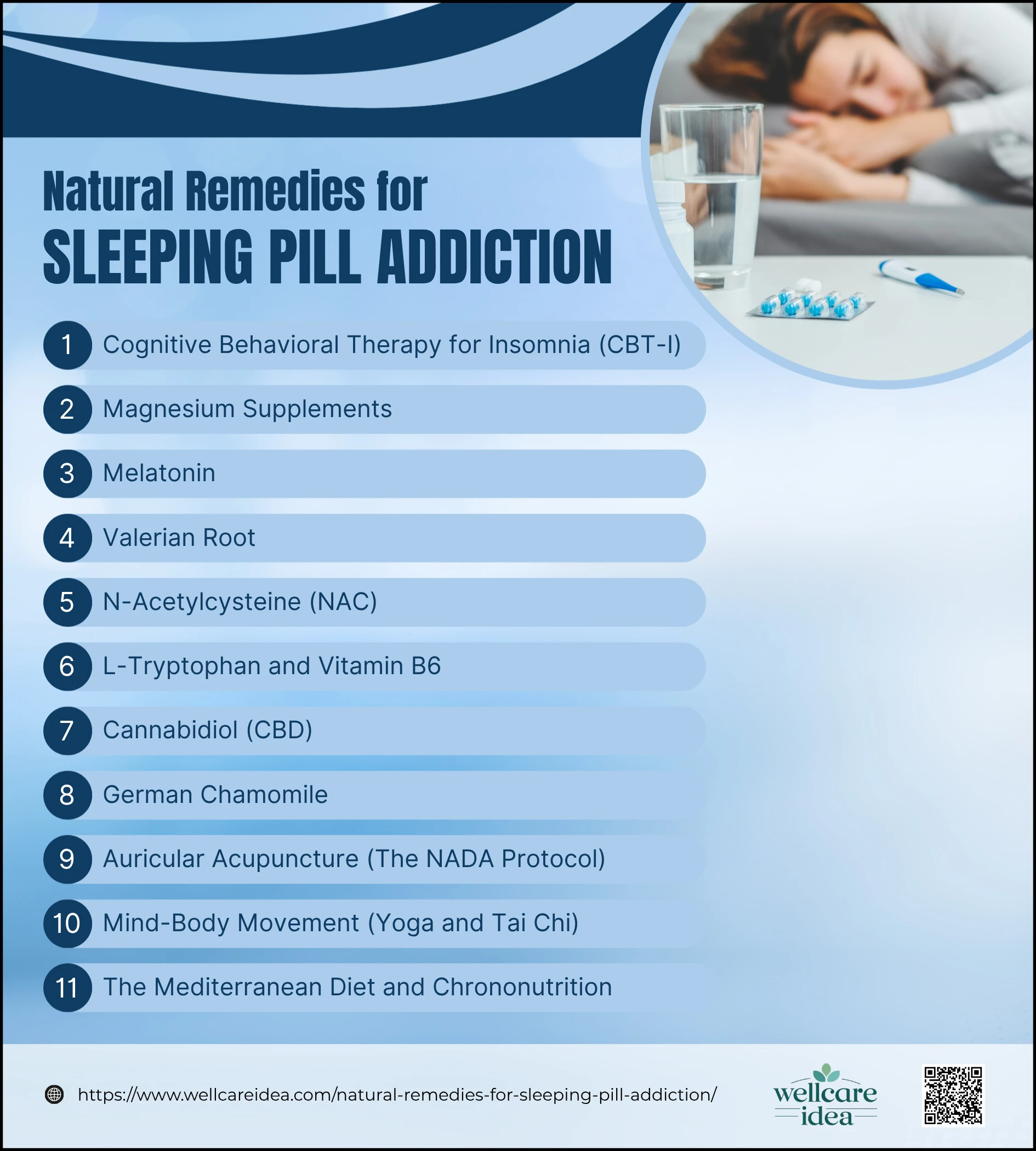 Natural Remedies for Sleeping Pill Addiction
When you finally begin to lower your medication dose under the guidance of your doctor, you need reliable tools to help your body rediscover its natural rhythm. Utilizing holistic and natural remedies provides your brain with the raw materials and environmental cues it needs to initiate sleep without chemical force. Here is a detailed listicle of the most effective natural interventions to aid your recovery.
1. Cognitive Behavioral Therapy for Insomnia (CBT-I)
Far beyond just a simple natural remedy, Cognitive Behavioral Therapy for Insomnia is actually the most effective non-medical treatment available for chronic sleep issues 17. Unlike sleeping pills that simply force you into an unconscious state while masking your anxiety, CBT-I works by helping you unlearn the negative thoughts and behaviors that are keeping you awake 23 This therapy utilizes specific techniques like sleep restriction to build up your natural sleep drive, and stimulus control to ensure your brain only associates your bed with sleep, rather than wakeful frustration 23 Research consistently shows that patients who use CBT-I while tapering off their medications have a significantly higher success rate of staying drug-free in the long run compared to those who just taper without behavioral support 24.
2. Magnesium Supplements
If you want to support your nervous system as it heals, ensuring you have adequate magnesium levels is an excellent starting point. Magnesium is a vital mineral that helps your body regulate the stress hormone cortisol, and it also binds to the exact same calming GABA receptors in your brain that your sleeping pills used to target 18. Unfortunately, chronic stress and long-term medication use can deplete your body’s magnesium stores, which only makes your withdrawal anxiety worse. Taking highly absorbable forms of this mineral, such as magnesium glycinate or magnesium threonate, has been shown to improve sleep quality, ease tight muscles, and significantly reduce overall anxiety during the recovery process 25.
3. Melatonin
You have probably heard of melatonin, as it is one of the most widely used over-the-counter sleep aids in the world. Melatonin is a naturally occurring hormone produced by your brain in response to darkness, signaling to your body that it is time to wind down 18. When you stop taking prescription hypnotics, your internal clock is often completely out of sync, making melatonin a helpful tool for gently resetting your sleep-wake cycle 26. Studies have confirmed that melatonin supplements can effectively improve sleep quality and reduce the time it takes to fall asleep for people dealing with insomnia 27. However, less is usually more; experts advise keeping doses low, as taking massive amounts can cause daytime grogginess, vivid nightmares, and headaches 28.
4. Valerian Root
For centuries, herbalists have turned to the roots of the Valerian plant to calm frazzled nerves and induce sleep. Modern science has caught up with this ancient wisdom, revealing that compounds inside Valerian root actively interact with your brain’s GABA receptors to promote deep relaxation. In fact, it works by inhibiting the breakdown of GABA in your brain, ensuring that your natural calming chemicals stick around longer. Clinical analyses have proven that taking Valerian root can significantly reduce the amount of time you spend tossing and turning before falling asleep, making it a powerful ally when you are battling rebound insomnia 27
5. N-Acetylcysteine (NAC)
While it might sound like a complicated chemical, N-Acetylcysteine (NAC) is actually a naturally occurring amino acid supplement that is showing incredible promise for treating addiction cravings. When you are dependent on a substance, your brain’s reward center becomes highly disrupted, specifically involving a neurotransmitter called glutamate. NAC works uniquely by rebalancing these glutamate levels, which helps to quiet the obsessive thoughts and compulsive urges that drive you back to your pill bottle 29. Recent systematic reviews have highlighted that NAC supplementation provides noticeable benefits in attenuating substance cravings and alleviating the depressive symptoms that accompany withdrawal 30.
6. L-Tryptophan and Vitamin B6
To make your own natural sleep hormones, your body requires specific building blocks derived from your diet. L-Tryptophan is an essential amino acid that your brain uses to create serotonin, the chemical responsible for keeping your mood stable and calm 31. Serotonin is then eventually converted directly into melatonin to make you sleepy 32. When patients who are detoxing from drug dependence take L-Tryptophan supplements, often paired with Vitamin B6 to help the conversion process, studies show that it effectively alleviates short-term sleep disorders 33. By giving your body exactly what it needs to manufacture its own sleep chemicals, you rely less on external drugs.
7. Cannabidiol (CBD)
Derived from the hemp plant, Cannabidiol (CBD) has gained massive popularity for its ability to soothe the nervous system without causing any psychoactive high. Many people recovering from sleep medication addiction suffer from intense physical tension and hyperarousal, making it impossible to relax at night. Research into CBD indicates that it possesses potent anti-anxiety properties that can ease this transition 34. In clinical observations, the majority of patients taking CBD reported significant improvements in their anxiety scores within the very first month of treatment 35. Furthermore, systematic reviews suggest that CBD, whether used alone or in specific formulations, proves beneficial in alleviating the stubborn symptoms of insomnia without the risk of building a new addiction 36.
8. German Chamomile
Sometimes the simplest remedies hold profound physiological benefits. German Chamomile is one of the most widely used medicinal plants globally, known primarily for treating nervous stomachs and anxiety. The magic of chamomile lies in its specific flavonoids, which interact directly with the exact same benzodiazepine receptors in your brain that prescription sleeping pills target. Because this interaction is gentle and non-addictive, drinking a strong cup of chamomile tea before bed serves as an excellent, safe way to trigger the sleep-wake transition 32.
9. Auricular Acupuncture (The NADA Protocol)
If you are open to alternative therapies, ear acupuncture has a well-documented history in the field of addiction recovery. The National Acupuncture Detoxification Association (NADA) developed a specific protocol that involves placing fine needles into five specific points on the ear to help individuals detoxify from substances. This quiet, non-verbal therapy is known to stimulate the parasympathetic nervous system, drastically reducing stress and physical agitation 37. Clinical studies tracking patients using the NADA protocol reveal that it has a highly positive effect on overall sleep quality, reducing the severe withdrawal symptoms that normally cause people to relapse 38.
10. Mind-Body Movement (Yoga and Tai Chi)
When your mind is racing and your body feels tightly wound from withdrawal, forcing yourself to lie perfectly still in bed usually backfires. Engaging in gentle, mind-body movement practices like Yoga and Tai Chi helps to naturally burn off excess adrenaline while teaching your body how to consciously relax. These practices combine physical postures with deep, rhythmic breathing, which lowers your heart rate and signals safety to your brain 39. Extensive research data confirms that practicing Tai Chi or Yoga is highly effective at improving overall sleep quality and easing insomnia, often performing better than traditional aerobic exercises for sleep restoration 40.
11. The Mediterranean Diet and Chrononutrition
Believe it or not, the food you put into your body has a massive impact on your ability to sleep. Nutritional psychiatry heavily advocates for the Mediterranean Diet, which is rich in fresh vegetables, legumes, whole grains, and healthy fats. This specific way of eating naturally provides your body with high levels of tryptophan, magnesium, and melatonin-boosting nutrients 41 Multiple observational studies highlight that sticking closely to a Mediterranean diet is strongly associated with longer sleep duration and significantly better sleep quality 42. Additionally, practicing “chrononutrition”—which means timing your meals properly by avoiding heavy foods and alcohol right before bed—prevents digestive disruptions from waking you up in the middle of the night 43.
Managing Rebound Insomnia
One of the most terrifying aspects of stopping your sleeping pills is the inevitable night when sleep simply refuses to come. This is known as rebound insomnia, and it happens because your brain, suddenly deprived of its chemical crutch, goes into a state of hyperarousal {https://www.helpguide.org/wellness/sleep/sleeping-pills-and-natural-sleep-aids]. Navigating this phase without panicking or reaching for the pill bottle requires a solid game plan and a few key lifestyle modifications.
Focusing on your physical environment is an easy first step. Science shows that your body needs to experience a drop in core temperature to properly trigger the desire to sleep 44. Research confirms that keeping your bedroom incredibly cool, or even using specialized cooling caps, can dramatically improve sleep for those suffering from insomnia 44. You also need to relentlessly protect your circadian rhythm by exposing yourself to natural sunlight first thing in the morning, and strictly avoiding the blue light from your phone or television at least an hour before bed 18.
Equally important is managing your behavior when you are awake in the middle of the night. If you have been tossing and turning for twenty minutes, you must get out of bed and do something calming in a dimly lit room until you feel genuinely tired 18. Lying in bed feeling angry and anxious only trains your brain to associate your mattress with stress, creating a negative feedback loop that is incredibly difficult to break 23. Furthermore, you must wake up at the exact same time every single day, even on weekends or after a terrible night of sleep, to ensure your body’s sleep drive builds up heavily for the following night 23.
The Role of Peer Support
Tackling addiction is rarely successful when done in total isolation. Because dependency thrives in secrecy and shame, opening up to others who genuinely understand what you are going through can be profoundly healing 45. Peer support groups provide a totally unique, non-clinical environment where you can share your struggles without fear of judgment 46.
Finding a community, whether through 12-step programs like Narcotics Anonymous (NA) or secular alternatives like SMART Recovery, gives you access to people who have already successfully navigated the exact withdrawal symptoms you are currently dreading 47. Engaging in these mutual-help organizations facilitates recovery-focused communication that actually helps buffer against intense cravings 48. By hearing other people’s success stories and sharing your own daily challenges, you significantly reduce the stigma you might be holding against yourself, diminishing feelings of loneliness and replacing them with a shared sense of accountability and hope 47.
Precaution Before Use of Natural Remedies
Before you rush out to purchase a cabinet full of herbal teas and supplements, it is absolutely critical to understand the safety protocols associated with natural remedies. Just because a substance is derived from a plant does not mean it is entirely harmless, especially when your central nervous system is in a delicate state of recovery 49.
Your primary concern must be potential interactions between natural supplements and any prescription medications you are currently taking, including the sleeping pills you are trying to taper off. Herbal medicines can significantly alter how your liver metabolizes other drugs, leading to dangerous build-ups or unintended side effects. For instance, taking an herbal sedative like Kava carries known risks of liver toxicity and can cause excessive, dangerous sedation if mixed with prescription downers or alcohol 50. Similarly, combining multiple natural sleep aids that boost serotonin, like L-Tryptophan, with prescription antidepressants can lead to an overload of serotonin in your brain, causing severe medical complications 51.
You also have to be mindful of the fact that over-the-counter dietary supplements are not tightly regulated by the FDA in the same way that prescription drugs are 49. This means that the purity, exact dosage, and quality of the supplement can vary wildly from brand to brand 27. It is highly recommended that you consult closely with your doctor or pharmacist before introducing any new supplement into your routine, so they can check for harmful interactions and recommend reputable brands 49.
Finally, and most importantly, natural remedies should never be used as an excuse to suddenly stop taking your prescription sleeping pills cold turkey. The absolute best, safest way to stop taking sedatives is to gradually reduce your dose under the strict guidance of a healthcare professional. Natural remedies are there to act as a gentle support system that eases your transition during a structured taper, not as an abrupt replacement 52. By combining medical supervision, holistic sleep aids, and robust behavioral changes, you can safely navigate the difficult road of withdrawal and ultimately reclaim your ability to sleep naturally.