
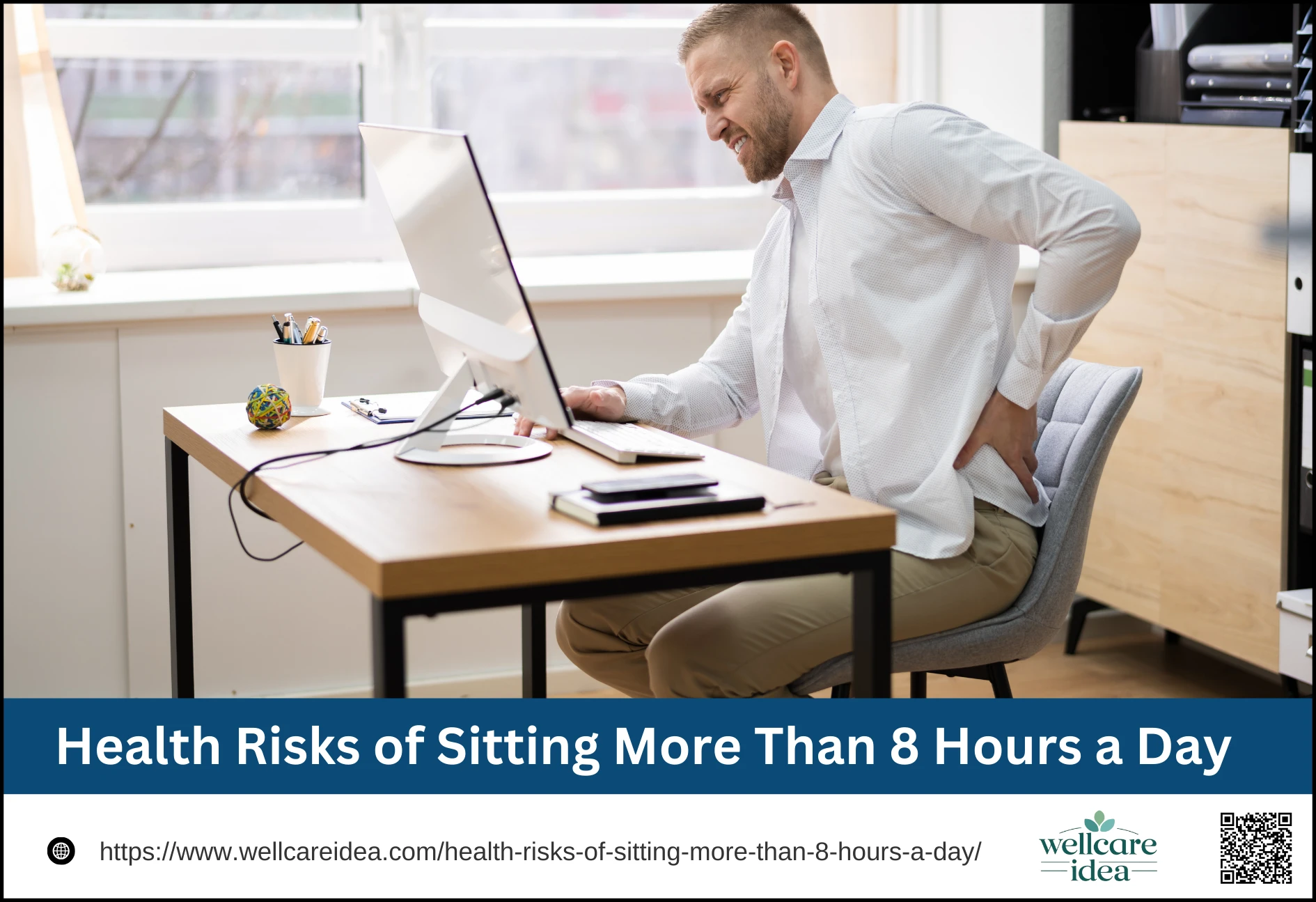
What is “Sitting More Than 8 Hours a Day”?
Modern lifestyles have shifted dramatically toward sedentary behaviors, defined as any waking behavior characterized by an energy expenditure of 1.5 metabolic equivalents (METs) or less while in a sitting, reclining, or lying posture. For many office workers, drivers, and students, “sedentary time” often exceeds 8 hours daily. This specific duration—eight hours—has been identified by researchers as a critical threshold where the risk of chronic disease and premature death begins to rise exponentially, independent of physical activity levels 1 It represents a state of prolonged muscular inactivity that triggers distinct physiological processes different from simply “not exercising.”
Health Risks of Sitting More Than 8 Hours a Day
1. Impact on Heart Health and Cardiovascular Systems
Prolonged inactivity significantly compromises heart function by allowing fatty acids to accumulate in the blood vessels rather than being broken down by muscles. Research indicates that individuals who sit for more than 10 hours a day may face a 40% to 60% higher risk of cardiovascular events compared to those who sit less 2 Furthermore, studies comparing activity levels have found that people sitting more than 8 hours a day with no physical activity have a risk of dying from heart disease similar to that posed by obesity and smoking 3
2. Increased Susceptibility to Metabolic Syndrome and Type 2 Diabetes
The body’s ability to regulate blood sugar is severely hampered by extended periods of rest. When muscles are inactive, their sensitivity to insulin drops, leading to higher blood sugar levels and an overproduction of insulin by the pancreas. A systematic review and dose-response meta-analysis found a linear relationship between sitting time and type 2 diabetes, with the risk increasing significantly after 6 to 8 hours of total sitting per day 1 Even in individuals who are otherwise physically active, this sedentary behavior remains an independent risk factor for metabolic dysfunction 4
3. Mechanisms of Weight Gain and Obesity
Caloric expenditure drops to nearly one calorie per minute during sitting, and the enzymes responsible for breaking down fats, such as lipoprotein lipase, become deactivated. This metabolic slowdown affects the body’s ability to metabolize fat, leading to weight gain. The Mayo Clinic notes that excessive sitting is thought to slow the metabolism, which directly impacts the body’s ability to regulate blood pressure and break down body fat 5 This biological stalling creates a direct pathway to obesity, distinct from the weight gain caused merely by overeating.
4. Spinal Strain and Musculoskeletal Disorders
Static postures place immense pressure on the intervertebral discs and spinal ligaments, often exceeding the strain caused by standing or moving. A cross-sectional study on employees found that prolonged sitting, especially with poor posture, is a major contributor to lower back and neck pain, with lower back pain being the most prevalent issue among sitting professionals 6 Over time, this can lead to permanent misalignment of the cervical vertebrae and chronic pain conditions 7
5. Gluteal Amnesia and Muscle Atrophy
Transitioning from an active state to a sedentary one leads to rapid oxidative stress and atrophy in load-bearing muscles, particularly the legs and glutes. Recent animal studies have shown that sedentary behavior causes a significant reduction in muscle mass (atrophy) and antioxidant enzyme activities in the soleus muscle 8 In humans, this disuse leads to sarcopenia (accelerated muscle loss) and functional decline, making daily movements more difficult as one ages 9
6. Circulatory Stagnation and Deep Vein Thrombosis (DVT)
Immobility causes blood to pool in the legs (venous stasis), which significantly increases the risk of clot formation. This condition, known as Deep Vein Thrombosis (DVT), can be life-threatening if a clot travels to the lungs. Risk factors for DVT include immobility due to bedrest or travel, but research emphasizes that “sitting pathology” applies to office environments as well, where sluggish blood flow increases the risk of clot formation 10 The risk is compounded in individuals with other risk factors such as obesity or advancing age 11
7. Mental Health Correlation: Anxiety and Depression
There is a distinct dose-response association between the number of hours spent sitting and the deterioration of mental well-being. A study involving over 42,000 people found that individuals with depression spent significantly more daily minutes in sedentary behavior, and those sitting more than 8 hours a day had nearly double the odds of having high sedentary levels compared to non-depressed individuals 12 Further research on college students confirmed that sedentary behavior is positively associated with anxiety, depression, and suicidal ideation, independent of physical activity levels 13
8. Elevated Risk of Specific Cancers
Sedentary behavior has been linked to an increased risk of several types of cancer, potentially due to inflammation, weight gain, and hormonal changes. Research highlights that for every two-hour increase in sitting time, the risk for colon and endometrial cancers rises significantly 14 Evidence suggests that prolonged sitting increases the risk of three specific cancers—colon, endometrial, and lung—and that reducing sitting time by just one hour a day could reduce the risk of premature death significantly 15
9. Cognitive Function and Brain Health
Brain health relies on proper blood flow and glucose regulation, both of which are impaired by long durations of inactivity. Sedentary behavior has been linked to medial temporal lobe thinning, which is a precursor to memory decline 16 Furthermore, poor glycemic control resulting from sedentary behavior is suggested to be a key mechanism linking sitting to cognitive decline and dementia risk 17
10. Association with Premature Mortality
The cumulative effect of the risks listed above is a higher likelihood of early death from all causes. A comprehensive meta-analysis established a threshold of 6 to 8 hours of total sitting per day, above which the risk for all-cause and cardiovascular mortality increases 1 While some studies suggest caution in interpreting sitting as a standalone risk factor without considering low energy expenditure 18 the consensus remains that high levels of sitting, particularly exceeding 8 hours, are detrimental to longevity.