

What is Cordyceps Militaris?
Cordyceps militaris is a species of medicinal fungus belonging to the family Cordycipitaceae. Unlike its wild counterpart Cordyceps sinensis—which parasitizes caterpillars in the high Himalayas—C. militaris can be cultivated in controlled environments on rice or grain substrates. This cultivation method makes it a sustainable and commercially viable source of bioactive compounds, most notably cordycepin (3′-deoxyadenosine) and adenosine. These compounds are the primary drivers behind the mushroom’s potent biological activities, distinguishing it as a functional food and therapeutic agent in modern integrative medicine.
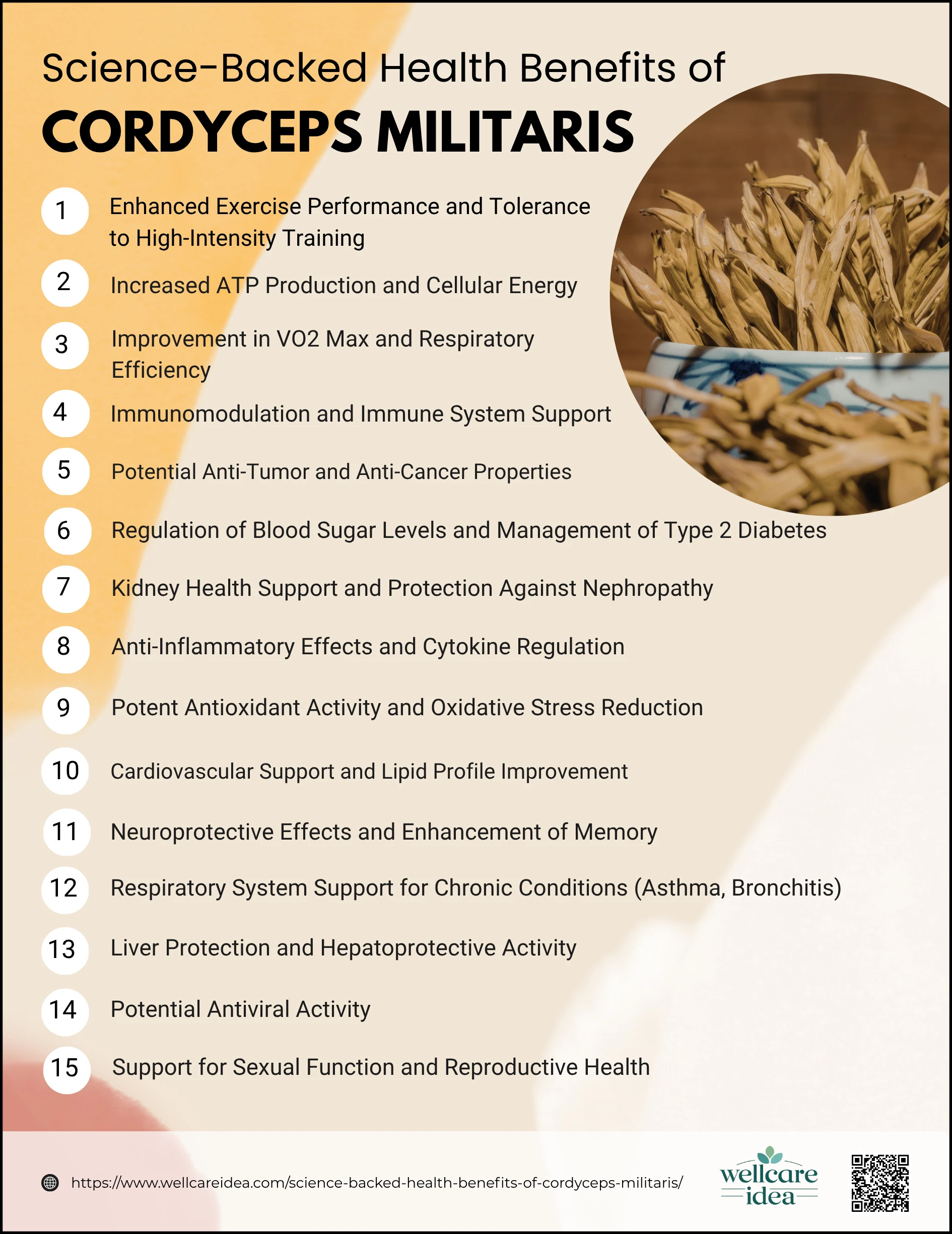 Science-Backed Health Benefits of Cordyceps Militaris
1. Enhanced Exercise Performance and Tolerance to High-Intensity Training
Athletes and fitness enthusiasts often utilize this fungus to push past physical plateaus. Research indicates that supplementation can significantly improve tolerance to high-intensity exercise after both acute and chronic use. A study involving healthy individuals found that three weeks of supplementation led to improved time to exhaustion and ventilatory threshold, allowing subjects to train harder for longer periods without fatigue 1
2. Increased ATP Production and Cellular Energy
The fundamental mechanism behind this energy boost lies in the mushroom’s ability to influence cellular energetics. Cordyceps militaris extracts have been shown to upregulate the production of Adenosine Triphosphate (ATP), the primary energy currency of the cell. This increase in ATP generation supports muscle contraction and delays the onset of muscle fatigue during physical exertion 2
3. Improvement in VO2 Max and Respiratory Efficiency
Optimizing how the body uses oxygen is critical for endurance. Clinical trials have demonstrated that consistent intake of Cordyceps militaris can lead to statistically significant improvements in VO2 max—the maximum rate of oxygen consumption measured during incremental exercise. This suggests that the fungi help the cardiovascular system deliver oxygen more efficiently to active muscles 3
4. Immunomodulation and Immune System Support
The fungal polysaccharides found in C. militaris act as biological response modifiers. These compounds have been observed to stimulate macrophage activity and enhance the production of cytokines, effectively “waking up” the immune system to defend against pathogens. This immunomodulatory effect helps balance the immune response, boosting underactive defenses while potentially suppressing overactive ones 4
5. Potential Anti-Tumor and Anti-Cancer Properties
Bioactive components like cordycepin have attracted significant attention in oncology research. Studies suggest that these compounds may induce apoptosis (programmed cell death) in various cancer cell lines, including breast, lung, and liver cancers. The mechanisms involve disrupting the cell cycle of tumor cells and inhibiting the formation of new blood vessels (angiogenesis) that tumors need to grow (https://www.ncbi.nlm.nih.gov/books/NBK92758/
6. Regulation of Blood Sugar Levels and Management of Type 2 Diabetes
Metabolic health is another key area where this mushroom shows promise. Animal studies using diabetic models have shown that Cordyceps militaris extracts can significantly lower blood glucose levels. The active compound cordycepin aids in improving glucose tolerance and may mimic the action of insulin, offering a potential complementary approach for managing type 2 diabetes 5
7. Kidney Health Support and Protection Against Nephropathy
Renal protection is a traditional use that has been validated by modern science. Research indicates that the aqueous extracts of the fruit body can protect against diabetic nephropathy (kidney damage) by reducing levels of creatinine and blood urea nitrogen. These renoprotective effects are attributed to the reduction of oxidative stress within kidney tissues 6
8. Anti-Inflammatory Effects and Cytokine Regulation
Chronic inflammation is a root cause of many modern diseases. Cordyceps militaris exerts powerful anti-inflammatory effects by inhibiting the production of pro-inflammatory mediators such as nitric oxide and TNF-alpha. This regulation of inflammatory pathways makes it a valuable candidate for managing conditions characterized by excessive inflammation 7
9. Potent Antioxidant Activity and Oxidative Stress Reduction
Cellular damage from free radicals contributes to aging and disease. The fungus is rich in antioxidants that scavenge these free radicals, thereby reducing oxidative stress. By boosting the activity of endogenous antioxidant enzymes like superoxide dismutase (SOD), C. militaris helps protect cells from DNA damage and lipid peroxidation 8
10. Cardiovascular Support and Lipid Profile Improvement
Heart health can be supported through the modulation of cholesterol levels. Studies on hyperlipidemic mice have shown that polysaccharides from C. militaris can decrease total cholesterol and triglycerides while inhibiting the formation of atherosclerotic plaques. This lipid-lowering effect contributes to reduced risk of atherosclerosis and other cardiovascular diseases 9
11. Neuroprotective Effects and Enhancement of Memory
Cognitive decline and neuronal injury are major health concerns addressed by this fungus. Research demonstrates that Cordyceps militaris can protect neuronal cells from ischemic injury (damage caused by lack of blood flow) and improve memory impairment in animal models. These neuroprotective effects are linked to the mitigation of oxidative stress and inflammation in the brain 10
12. Respiratory System Support for Chronic Conditions (Asthma, Bronchitis)
Traditionally used to protect the lungs, modern science supports its efficacy in respiratory health. The anti-inflammatory properties of the fungus help relax bronchial walls and reduce airway inflammation, which is beneficial for conditions like asthma and chronic bronchitis. It aids in improving airflow and reducing the severity of respiratory distress symptoms 11
13. Liver Protection and Hepatoprotective Activity
The liver serves as the body’s primary detoxification organ, and C. militaris helps safeguard its function. Evidence shows that the mushroom can prevent liver fibrosis and protect against hepatotoxicity caused by alcohol or chemical agents. This hepatoprotective activity is mediated by the inhibition of inflammatory responses and the preservation of liver cell integrity 12
14. Potential Antiviral Activity
Beyond bacteria, the fungus also defends against viral pathogens. Nucleosides found in C. militaris, particularly cordycepin, function as analogs to adenosine, interfering with viral RNA replication. This antiviral mechanism has been studied in the context of various viral infections, suggesting a broad-spectrum potential for viral defense 4
15. Support for Sexual Function and Reproductive Health
Enhancing vitality and reproductive health is one of the oldest recorded uses of Cordyceps. Scientific investigations confirm that it can improve sperm quality and quantity in animal models. Furthermore, it ameliorates age-related testicular dysfunction by modulating sex hormone receptors and reducing oxidative damage in reproductive tissues 13
Conclusion
Cordyceps militaris stands out as a potent functional food with a diverse range of scientifically validated health benefits. From enhancing physical performance and energy metabolism to modulating the immune system and protecting vital organs, the bioactive compounds within this mushroom offer a multi-faceted approach to wellness. As research continues to uncover the depth of its therapeutic potential, C. militaris remains a compelling natural agent for those seeking to optimize their health through evidence-based supplementation.