
Belly fat ranks among the most common fitness concerns globally, not merely for aesthetic reasons but for its significant implications for overall health. Unlike fat stored in other areas, abdominal fat is metabolically active and can pose serious health risks, including cardiovascular disease and type 2 diabetes. It is crucial to understand that spot reduction, or losing fat from a specific area through targeted exercises, is a myth; a study dedicated to abdominal exercises found they alone did not reduce abdominal fat. Effective reduction requires a comprehensive approach that combines full-body workouts to burn calories and a balanced diet to create a sustainable energy deficit. This article will explore science-backed exercises that help reduce overall body fat, including that stubborn belly area, while providing practical guidance for incorporating them into a balanced fitness regimen.
Abdominal fat consists of two types: subcutaneous fat under the skin and the more dangerous visceral fat surrounding internal organs. Visceral fat is metabolically active, secreting inflammatory substances that increase chronic disease risk. Its accumulation is driven by factors like poor diet, sedentary behavior, hormonal changes, and inadequate sleep. To combat this, regular exercise is essential. Physical activity boosts metabolism and builds calorie-burning lean muscle, directly targeting harmful visceral fat. For significant results, the American College of Sports Medicine recommends over 250 minutes of weekly activity to prevent weight regain, highlighting that consistent exercise is a powerful tool for reducing belly fat.
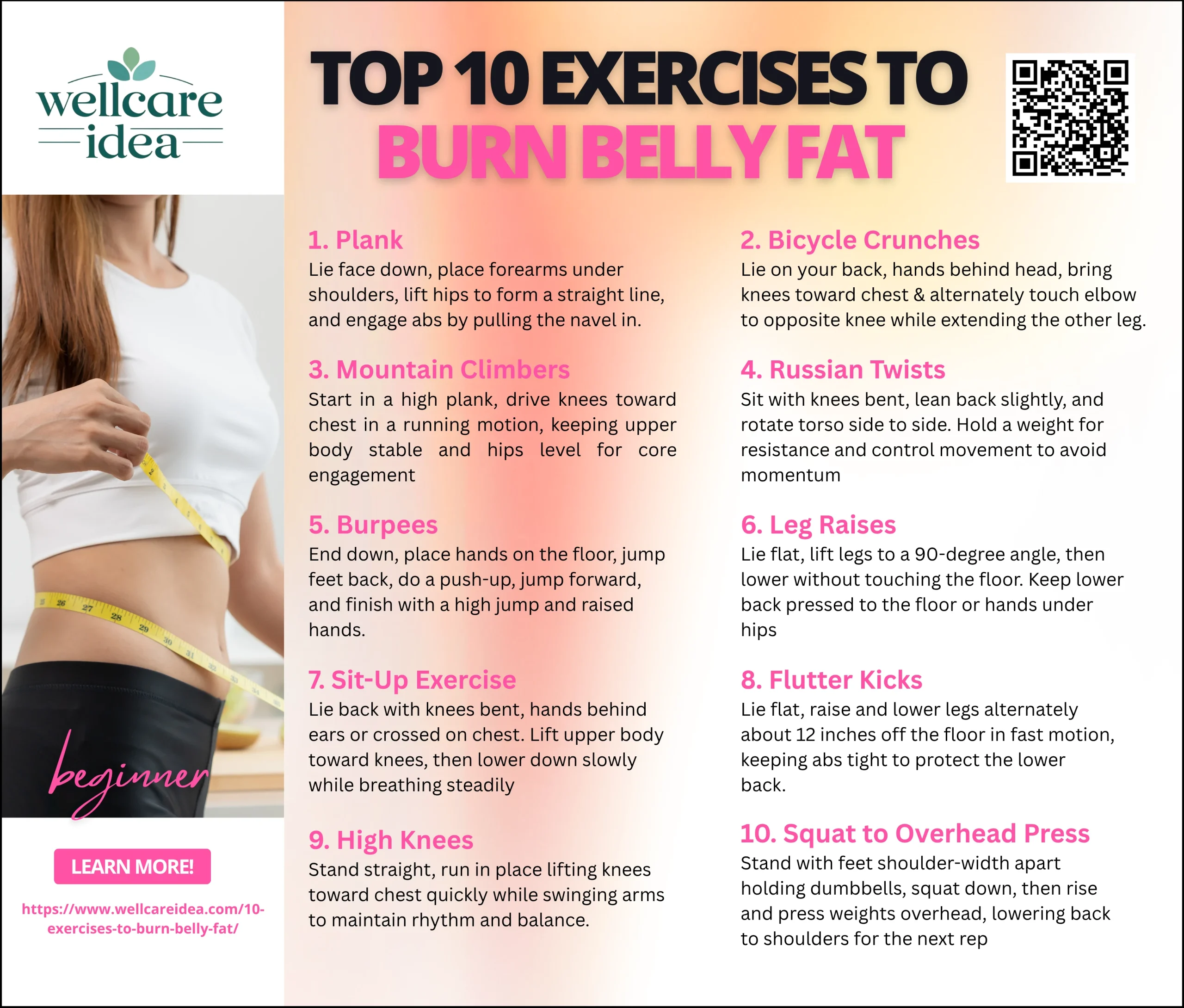 Top 10 Exercises to Burn Belly Fat
Exercise 1: Plank
The plank is a fundamental core stabilization exercise that builds endurance in the entire abdominal wall, back, and shoulders. By maintaining a neutral spine against gravity, it engages the deep core muscles that support proper posture and spinal health.
How to do: Begin face down, place forearms on the ground with elbows aligned under shoulders, lift hips to form a straight line from head to heels, and engage abdominal muscles by drawing the navel toward the spine.
Common mistakes include sagging hips or raising the buttocks too high, both of which reduce core activation. Beginners should aim for 20-30 second holds, progressing to 60 seconds as endurance improves.
Exercise 2: Bicycle Crunches
Bicycle crunches effectively engage both the upper and lower abdominal muscles as well as the obliques. Research that analyzed popular abdominal exercises found this movement generated among the highest muscle activation in the rectus abdominis (the “six-pack” muscle).
How to do: Lie on your back with hands behind your head, bring knees toward chest, and alternately touch elbow to opposite knee while extending the other leg.
The key is to focus on controlled rotation rather than speed, and avoid pulling on the neck. Aim for 2-3 sets of 15-20 repetitions per side.
Exercise 3: Mountain Climbers
Mountain climbers provide both core strengthening and cardiovascular benefits through dynamic movement. This exercise engages the entire core while elevating heart rate, increasing calorie burn.
How to do: Starting in a high plank position, alternately drive knees toward the chest in a running motion while maintaining a stable upper body. Keep hips level rather than hiking them upward to maximize core engagement.
Variations in speed—from slow and controlled to rapid bursts—can adjust intensity. Perform for 30-60 seconds intervals.
Exercise 4: Russian Twists
Russian twists specifically target the oblique muscles that define the waistline.
How to do: sit with knees bent, lean back slightly to engage abs, and rotate torso from side to side. For added resistance, hold a weight or medicine ball. Avoid using momentum by controlling the movement throughout the rotation.
This exercise helps build rotational core strength that supports daily movements and protects the spine. Complete 2-3 sets of 12-16 repetitions total (6-8 per side).
Exercise 5: Burpees
Burpees represent one of the most efficient full-body exercises for calorie burning, combining strength and cardiovascular elements in a single movement.
How to do: Bend down, put your hands on the floor, jump your feet back, do a push-up, jump your feet forward again, and then jump up high with your hands in the air.
This intensity makes burpees particularly effective for stimulating metabolic rate and fat loss. Modify by stepping back instead of jumping, or eliminating the push-up for beginners. Perform in intervals of 30-45 seconds or complete 8-12 repetitions with good form.
Exercise 6: Leg Raises
Leg raises specifically target the lower abdominal region, which often proves challenging to strengthen.
How to do: Lying supine with legs extended, slowly raise them toward a 90-degree angle with the floor, then lower them back down without touching the floor. To protect the lower back, maintain contact between the lumbar spine and the floor, or place hands beneath the hips for support.
Beginners can bend knees or perform single-leg variations. Aim for 2-3 sets of 10-15 repetitions with controlled movement.
Exercise 7: Sit-Up Exercise
Sit-ups are a classic core-strengthening exercise that primarily target the abdominal muscles while also engaging the hip flexors and lower back. This movement helps build a strong and stable core, which is essential for balance, posture, and efficient fat metabolism. Performing sit-ups regularly can enhance abdominal endurance and support fat burning when combined with overall cardio and strength training.
How to Perform: Lie flat on your back with knees bent and feet anchored on the floor. Place your fingertips behind your ears or cross your arms over your chest. Engage your core muscles to lift your upper body toward your knees, then slowly lower yourself back down to the starting position. Breathe out as you rise and inhale as you return.
Avoid pulling your neck or using momentum to lift your torso—focus on controlled core engagement. For variation, try weighted sit-ups or incline sit-ups to increase difficulty.
Exercise 8: Flutter Kicks
Flutter kicks engage the deep core muscles, particularly the lower abdominals and hip flexors, while challenging core stability.
How to do: Lying supine with legs extended, alternately raise and lower each leg approximately 12 inches from the floor in fast kicking motion. Avoid arching the lower back by engaging abdominal muscles throughout the movement.
This exercise builds endurance in the core stabilizers that support proper posture. Perform for 30-45 second intervals.
Exercise 9: High Knees
High knees combine cardiovascular exercise with core engagement through dynamic hip flexion. By rapidly bringing knees toward chest while maintaining an upright posture, this movement elevates heart rate while engaging abdominal muscles.
How to do: high knees, stand straight with your feet hip-width apart, then run in place while lifting your knees up toward your chest as high and fast as you can, swinging your arms to keep your balance and rhythm
High knees effectively boost heart rate quickly, making them ideal for warm-ups or HIIT intervals. Perform in 30-60 second bursts with high intensity.
Exercise 10: Squat to Overhead Press
This compound movement integrates lower body strength with upper body pushing, creating a full-body exercise that maximizes calorie burn and muscle engagement. The combination of a squat with an overhead press challenges core stability as the abdominal muscles must engage to transfer force between upper and lower body.
How to do: stand with your feet shoulder-width apart holding dumbbells at shoulder level, lower into a squat, then stand up and press the weights straight overhead, lowering them back to your shoulders as you return to the next squat.
This functional movement pattern builds metabolically active muscle while burning significant calories. Complete 2-3 sets of 10-15 repetitions.
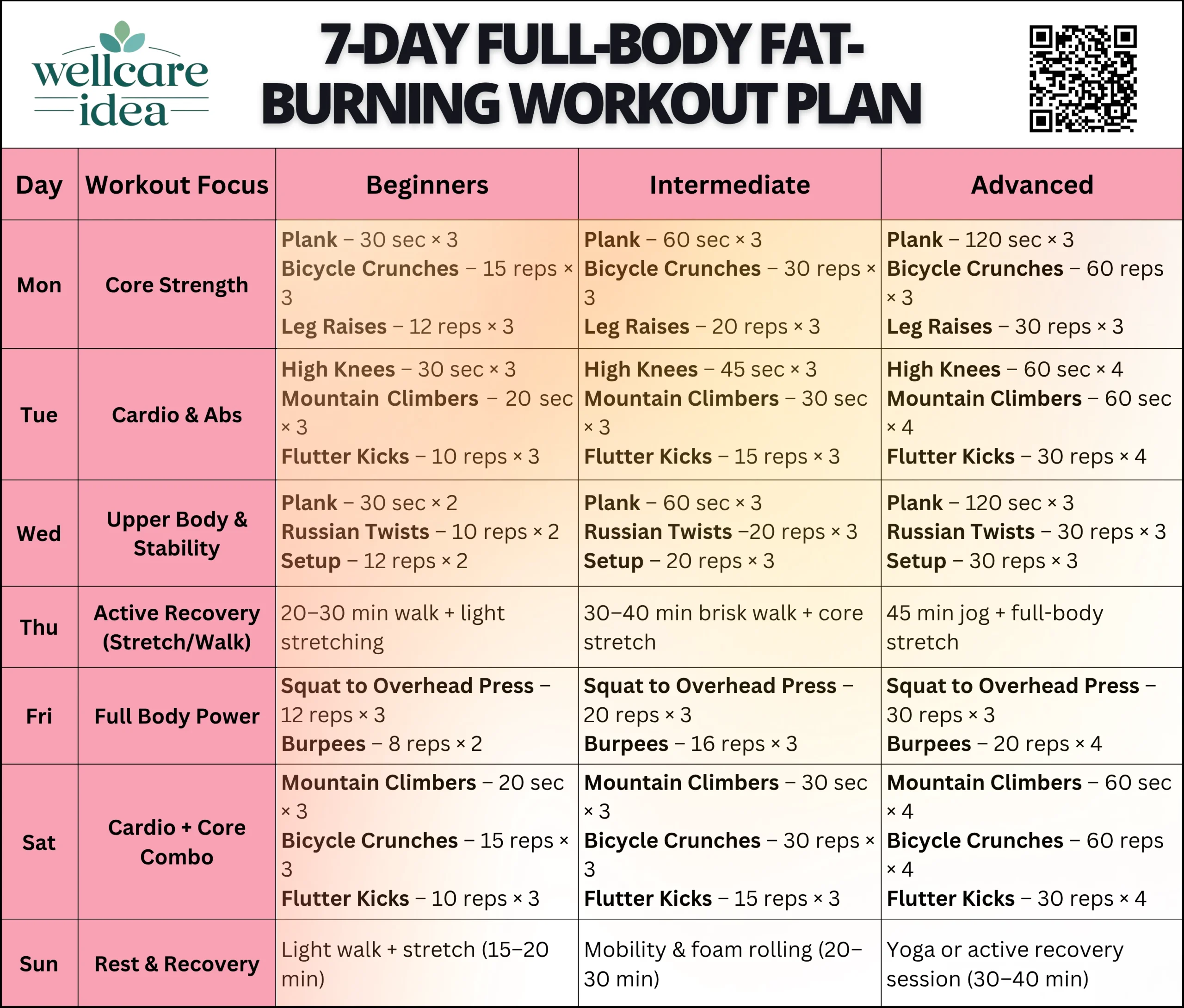 7-Day Full-Body Fat-Burning Workout Plan
This balanced program incorporates the recommended exercises while allowing adequate recovery:
| Day | Workout Focus | Beginners | Intermediate | Advanced |
| Mon | Core Strength | Plank – 30 sec × 3 Bicycle Crunches – 15 reps × 3 Leg Raises – 12 reps × 3 |
Plank – 60 sec × 3 Bicycle Crunches – 30 reps × 3 Leg Raises – 20 reps × 3 |
Plank – 120 sec × 3 Bicycle Crunches – 60 reps × 3 Leg Raises – 30 reps × 3 |
| Tue | Cardio & Abs | High Knees – 30 sec × 3 Mountain Climbers – 20 sec × 3 Flutter Kicks – 10 reps × 3 |
High Knees – 45 sec × 3 Mountain Climbers – 30 sec × 3 Flutter Kicks – 15 reps × 3 |
High Knees – 60 sec × 4 Mountain Climbers – 60 sec × 4 Flutter Kicks – 30 reps × 4 |
| Wed | Upper Body & Stability | Plank – 30 sec × 2 Russian Twists – 10 reps × 2 Setup – 12 reps × 2 |
Plank – 60 sec × 3 Russian Twists –20 reps × 3 Setup – 20 reps × 3 |
Plank – 120 sec × 3 Russian Twists – 30 reps × 3 Setup – 30 reps × 3 |
| Thu | Active Recovery (Stretch/Walk) | 20–30 min walk + light stretching | 30–40 min brisk walk + core stretch | 45 min jog + full-body stretch |
| Fri | Full Body Power | Squat to Overhead Press – 12 reps × 3 Burpees – 8 reps × 2 |
Squat to Overhead Press – 20 reps × 3 Burpees – 16 reps × 3 |
Squat to Overhead Press – 30 reps × 3 Burpees – 20 reps × 4 |
| Sat | Cardio + Core Combo | Mountain Climbers – 20 sec × 3 Bicycle Crunches – 15 reps × 3 Flutter Kicks – 10 reps × 3 |
Mountain Climbers – 30 sec × 3 Bicycle Crunches – 30 reps × 3 Flutter Kicks – 15 reps × 3 |
Mountain Climbers – 60 sec × 4 Bicycle Crunches – 60 reps × 4 Flutter Kicks – 30 reps × 4 |
| Sun | Rest & Recovery | Light walk + stretch (15–20 min) | Mobility & foam rolling (20–30 min) | Yoga or active recovery session (30–40 min) |
💡 Notes
1. Rest between sets: 30 sec (Beginners), 20 sec (Intermediate), 10–15 sec (Advanced)
2. Warm-up: Always include 5–10 minutes of warm-up (jumping jacks, arm circles, light jog).
3. Cool-down: Stretch after every workout.
4. Goal: Improve endurance, core strength, and full-body coordination over 4–6 weeks.
Common Mistakes to Avoid
Several common errors can hinder progress in reducing belly fat. Overtraining abdominal muscles without incorporating full-body workouts is ineffective since spot reduction remains scientifically unsubstantiated . Neglecting dietary considerations undermines exercise efforts; creating a consistent calorie deficit remains essential for fat loss . Poor exercise form reduces effectiveness and increases injury risk, particularly with dynamic movements like burpees or Russian twists.
Safety and Precautions
Prior to beginning any new exercise program, proper warm-up prepares the body for activity and reduces injury risk. Include 5-10 minutes of light cardio and dynamic stretching before intense exercise. Similarly. After exercise cool-down with static stretching aid recovery and maintain flexibility.
Special concern for Individuals with back pain
Individuals with back pain should take particular care when performing abdominal exercises, choosing movements that maintain spinal stability. During the cool-down period after exercise, it is important to stretch and gently twist your back. To stretch your back, it is recommended to perform the Cobra Stretch, followed by the Lying Spinal Twist.
| Beginners | Intermediate | Advanced |
| Cobra Stretch – 45 Seconds Lying Spinal Twist – 30 Seconds each side |
Cobra Stretch – 2 Minute Lying Spinal Twist – 1 Minute each side |
Cobra Stretch – 3 Minute Lying Spinal Twist – 2 Minute each side |
Consult a healthcare provider before starting new exercises if you have chronic health conditions like cardiovascular disease, diabetes, or orthopedic limitations . Consider working with a qualified fitness professional to ensure proper technique, particularly when learning complex movements.