

What is Manuka Honey?
Derived from the nectar of the Leptospermum scoparium bush native to New Zealand, Manuka honey has transcended its role as a natural sweetener to become a subject of intense medical research. Unlike traditional honey, which relies primarily on hydrogen peroxide for its antimicrobial activity, Manuka honey possesses a unique, stable non-peroxide activity that remains potent even when exposed to bodily fluids. This distinct profile has led to its classification as a medical-grade product in clinical settings, bridging the gap between traditional naturopathy and modern pharmacological science.
Science-Backed Health Benefits of Manuka Honey
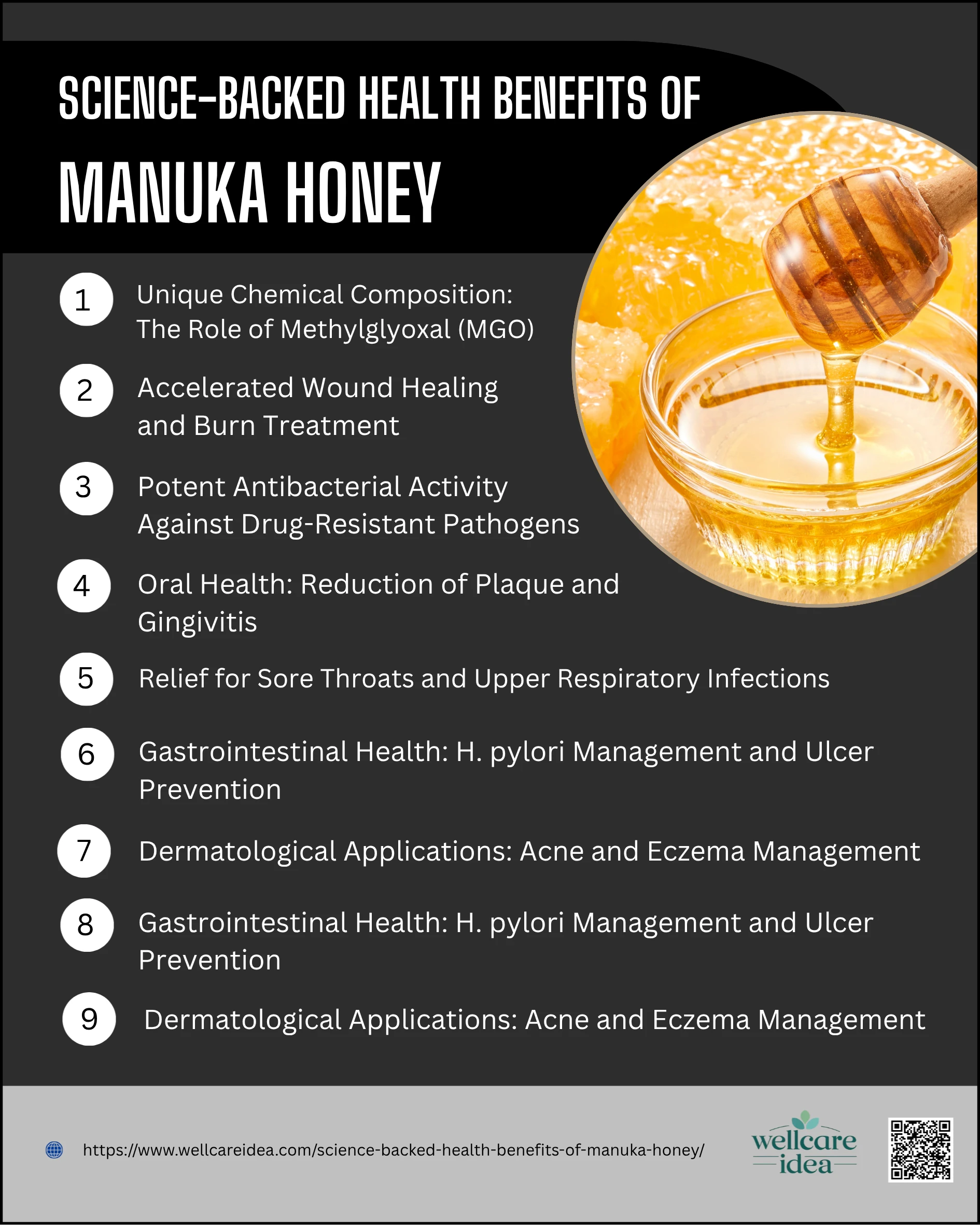
1. Unique Chemical Composition: The Role of Methylglyoxal (MGO)
Standard honey varieties largely depend on the enzyme glucose oxidase to produce hydrogen peroxide, which kills bacteria. However, this activity is easily neutralized by heat or digestive enzymes. In contrast, Manuka honey contains high concentrations of Methylglyoxal (MGO), a compound formed from the dehydration of dihydroxyacetone (DHA) found in the nectar of the Manuka flower 1 Research indicates that MGO is the primary active ingredient responsible for the honey’s stable antibacterial effects, with concentrations up to 100-fold higher than those found in conventional honey 2 This unique chemical marker allows scientists to grade the potency of the honey using the Unique Manuka Factor (UMF) rating system.
2. Accelerated Wound Healing and Burn Treatment
The medical community has formally recognized the efficacy of this substance in clinical wound care. In 2007, the US FDA approved Manuka honey-based wound dressings for use in treating wounds and burns. 3 The honey creates a moist healing environment while its high sugar content creates an osmotic effect that draws fluid away from the wound bed, effectively removing debris and bacteria. Furthermore, studies have shown that it promotes autolytic debridement (the removal of dead tissue) and stimulates tissue regeneration, making it a viable alternative for treating diabetic foot ulcers and pressure sores 4
3. Potent Antibacterial Activity Against Drug-Resistant Pathogens
With the global rise of antibiotic resistance, researchers are urgently seeking alternative antimicrobial agents. Manuka honey has demonstrated significant bactericidal activity against “superbugs” such as Methicillin-resistant Staphylococcus aureus (MRSA) and Vancomycin-resistant Enterococci (VRE). 5 Unlike synthetic antibiotics, which target specific bacterial mechanisms that pathogens can mutate to avoid, the honey works through multiple pathways—including disrupting cell division and degrading bacterial DNA—making it difficult for bacteria to develop resistance 6
4. Oral Health: Reduction of Plaque and Gingivitis
Despite its high sugar content, Manuka honey does not appear to contribute to tooth decay in the same way as refined sugar; in fact, it may protect oral health. Clinical trials comparing Manuka honey mouthwash to chlorhexidine (the standard pharmaceutical mouthwash) found that both were effective in significantly reducing dental plaque and gingival inflammation. 7 The honey’s antibacterial properties target oral pathogens like Porphyromonas gingivalis without damaging the sensitive tissues of the gums. 8
5. Relief for Sore Throats and Upper Respiratory Infections
Historically used as a folk remedy for colds, modern science supports the use of Manuka honey for soothing upper respiratory tract infections. Research highlights its ability to inhibit Streptococcus mutans, a bacteria often found in the throat and mouth, thereby reducing the bacterial load that causes pain and inflammation. 9 Additionally, the honey acts as a demulcent, forming a protective film over the throat lining that eases irritation and coughing, which is particularly beneficial for pediatric patients where over-the-counter medications may carry risks. 10
6. Gastrointestinal Health: H. pylori Management and Ulcer Prevention
Gastric ulcers are frequently caused by the bacterium Helicobacter pylori, which burrows into the stomach lining. While traditional antibiotic treatments can be harsh, studies suggest that Manuka honey inhibits the growth of H. pylori and may help prevent the formation of gastric lesions. 11 Beyond its antibacterial action, the honey helps maintain proper levels of mucosal glycoproteins and antioxidants in the stomach, which protects the lining from acid damage and inflammation 12
7. Dermatological Applications: Acne and Eczema Management
For individuals suffering from chronic skin conditions, the inflammatory and microbial components of Manuka honey offer a dual-action treatment. In cases of atopic dermatitis (eczema), the application of Manuka honey has been shown to down-regulate the release of inflammatory proteins and inhibit mast cell degranulation, leading to a reduction in lesion severity 13 Similarly, its ability to kill Propionibacterium acnes and reduce skin inflammation makes it a potentially effective natural therapeutic for acne management 14
8. Potential Efficacy Against Cystic Fibrosis Pathogens
One of the most promising areas of emerging research involves the treatment of chronic respiratory infections in Cystic Fibrosis (CF) patients. Pseudomonas aeruginosa and Burkholderia species are common, dangerous pathogens in CF lungs that often form antibiotic-resistant biofilms. Studies have demonstrated that Manuka honey can inhibit these pathogens at concentrations that are safe for human tissue, potentially disrupting the biofilm structure that protects the bacteria 15 Pilot trials using Manuka honey sinus irrigations have shown improvements in quality-of-life scores and endoscopic outcomes for patients with CF-associated rhinosinusitis 16
9. Systemic Anti-Inflammatory and Antioxidant Properties
Beyond specific localized treatments, Manuka honey serves as a rich source of systemic antioxidants. It contains high levels of flavonoids and phenolic compounds which scavenge free radicals, reducing oxidative stress throughout the body 17 This antioxidant capacity works in tandem with its anti-inflammatory effects to potentially lower the risk of chronic diseases associated with cellular damage and long-term inflammation. 18
Conclusion
The scientific evidence supporting the health benefits of Manuka honey distinguishes it clearly from standard table honey. From its unique MGO-driven antibacterial properties to its proven ability to accelerate wound healing and manage drug-resistant pathogens, it represents a powerful intersection of nature and medicine. While it should not replace prescribed medical treatments without professional consultation, the current body of research suggests Manuka honey is a potent, versatile tool for enhancing overall health and wellness.