We often think of aging as a purely physical process, marked by wrinkles, gray hair, and a decline in physical stamina. However, a growing body of scientific evidence reveals that our psychological state—our thoughts, feelings, and social connections—plays a powerful role in determining our rate of aging. Your biological age, which reflects the overall health and vitality of your cells and organs, can be significantly influenced by your mental and emotional world. This article explores the fascinating connection between your mind and your body’s aging process, providing research-backed insights into how managing stress, cultivating a positive mindset, and nurturing social bonds can help you cultivate a healthier, younger you.
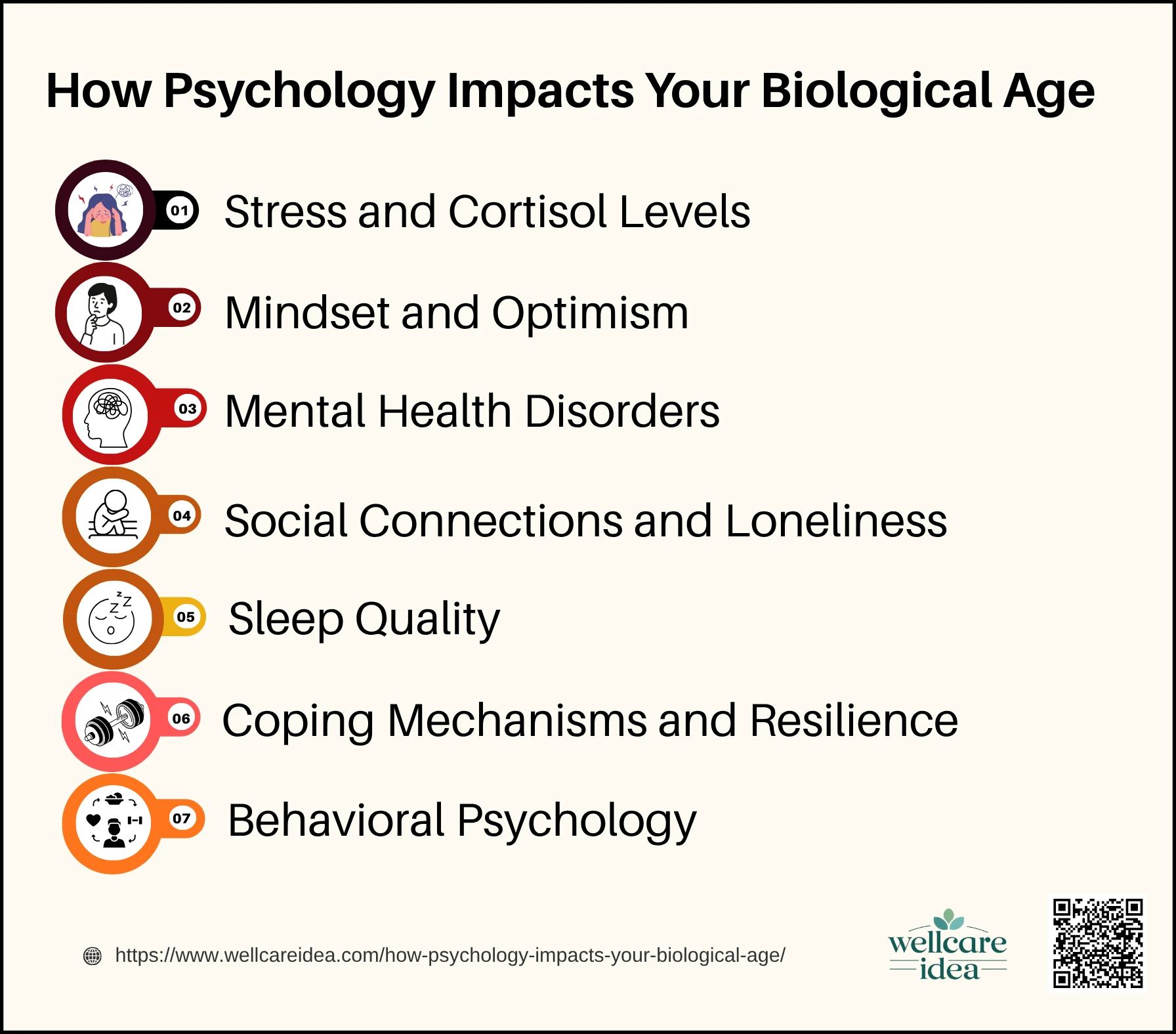
How Psychology Impacts Your Biological Age
1. Stress and Cortisol Levels
When you experience stress, your body activates its survival systems, releasing hormones like cortisol. In short bursts, this is adaptive. However, chronic stress leads to sustained high cortisol levels, which is biologically damaging. Research found that chronic pain sufferers with high long-term cortisol levels had a 71% chance of depression recurring, indicating a significant biological burden. In contrast, those with lower cortisol levels showed better mental health resilience. Chronically elevated cortisol contributes to inflammation, weakens the immune system, and can accelerate the aging of cells. The National Institutes of Health notes that prolonged activation of the stress response systems leads to “cumulative physiological and psychological effects, increasing the risk of health problems such as cardiovascular disease, anxiety, and depression” 1 This physiological wear and tear is a direct pathway through which stress can increase your biological age.
2. Mindset and Optimism
Your outlook on life is not just a state of mind—it’s a biological reality. A positive, optimistic mindset is consistently linked to better health outcomes and greater longevity. Positive thinking and optimism are key components of effective stress management and are associated with many health benefits, including “increased life span, lower rates of depression, lower levels of distress and pain, [and] greater resistance to illnesses” 2 Optimists tend to experience lower levels of inflammation and healthier cardiovascular function. This is partly because a positive outlook enables better coping during hardships, reducing the harmful health effects of stress on the body. Furthermore, optimistic people are more likely to engage in healthy behaviors like physical activity and maintaining a balanced diet, creating a positive feedback loop for longevity 3
3. Mental Health Disorders
Conditions like chronic depression and anxiety do more than impact mood; they exert a physical toll that can accelerate aging. The connection is often bidirectional. For instance, extensive research has drawn powerful links between mental health and sleep. People with insomnia, for example, are “10 times more likely to have depression and 17 times more likely to have anxiety than the general population,” creating a cycle where poor mental health and poor sleep fuel each other, exacerbating biological strain 4 A 2024 meta-analysis that reviewed 54 studies concluded that improving sleep quality significantly reduced symptoms of both depression and anxiety in adults 5 This interplay shows that untreated mental health disorders can lead to physiological dysregulation, including in the immune and endocrine systems, thereby increasing biological age.
4. Social Connections and Loneliness
Feeling lonely and socially isolated is a profound psychological stressor with severe consequences for physical health. The U.S. Surgeon General has declared loneliness an epidemic, highlighting that it is far more than just a “bad feeling” 6 Research found that 21% of American adults report serious feelings of loneliness, which is strongly correlated with anxiety, depression, and a lack of meaning and purpose 7 This type of existential loneliness—feeling fundamentally disconnected from others—can be as physically damaging as smoking. Loneliness triggers chronic inflammation and stress responses, contributing to a higher risk of heart disease, cognitive decline, and premature mortality. Strengthening social bonds is therefore not just a social goal, but a critical health intervention.
5. Sleep Quality and Psychological Well-being
Sleep is a cornerstone of health, and its relationship with psychology is deeply bidirectional. Researchers explain that “sleep and mood have a bidirectional relationship,” meaning that poor sleep can lead to poor mental health, and mental health conditions can cause sleep problems. When you don’t get enough quality sleep, your brain’s ability to regulate emotions diminishes. Furthermore, the timing of sleep matters for mental health; a large-scale study found that going to bed early and waking early is better for mental health, “even if they’re a night owl” 8 The “mind after midnight” theory suggests that late-night wakefulness can lead to poorer decision-making and heightened emotional vulnerability 9 Since deep sleep is essential for cellular repair, memory consolidation, and clearing neural waste, chronic sleep disruption accelerates biological aging by hindering these vital restorative processes.
6. Coping Mechanisms and Resilience
Resilience—the ability to bounce back from adversity—is a powerful modulator of the stress response. It is not an innate trait but a dynamic process that can be cultivated. A 2024 theoretical framework introduces the “ART of Resilience,” which stands for Acknowledgment, Reframe, and Tailoring 10 This model synthesizes cognitive, emotional, and physiological mechanisms for building resilience. It involves acknowledging resources and the reality of a situation, reframing threats into challenges through cognitive restructuring, and tailoring your coping strategies to fit the specific demands of the situation. Individuals with high resilience show better regulation of their nervous system, including higher heart rate variability, which is linked to greater emotional stability and cognitive adaptability under stress. By preventing the body from being stuck in a chronic stress state, effective resilience directly protects against accelerated biological aging.
7. Behavioral Psychology and Lifestyle Choices
Our psychology directly shapes the daily lifestyle choices that either promote health or accelerate aging. The concept of “identity-based habits” suggests that lasting change comes from aligning behaviors with how we see ourselves. Instead of focusing solely on an outcome like “lose weight,” this approach encourages building an identity, such as “I am someone who values health and vitality” 11 This shift taps into internal motivation, which is more sustainable than relying on willpower or external rewards. When habits are connected to personal values and bring intrinsic satisfaction, they are more likely to stick, leading to long-term adherence to healthy behaviors like regular exercise, nutritious eating, and avoiding excessive alcohol or tobacco—all of which are critical for maintaining a youthful biological age 12
Table: Psychological Factors and Their Impact on Biological Age
| Psychological Factor | Biological Impact | Potential Effect on Aging |
| Chronic Stress | Sustained high cortisol, increased inflammation, weakened immune function | Accelerated cellular aging, higher disease risk |
| Pessimism | Poorer stress management, higher distress, unhealthy lifestyle choices | Increased wear and tear on body systems |
| Loneliness | Activation of stress responses, increased inflammation | Higher risk of heart disease, cognitive decline |
| Poor Sleep | Disrupted cellular repair, impaired emotional regulation | Hindered physical restoration, worsened mental health |
| Low Resilience | Poor nervous system regulation, inflexible coping | Greater vulnerability to stress-related damage |
Practical Strategies to Reduce Biological Age Through Psychology
Understanding the mind-body connection is the first step; applying it is the next. Here are practical, evidence-based strategies to help you harness the power of your psychology to support a younger biological age.
1. Stress management techniques: meditation, yoga, deep breathing
Engaging in regular practices that activate the body’s relaxation response is crucial for counteracting chronic stress. Techniques like meditation, yoga, and deep breathing exercises help reduce cortisol levels, lower blood pressure, and improve heart rate variability (https://www.nccih.nih.gov/health/stress). The goal is to regularly shift the nervous system from a state of “fight-or-flight” to “rest-and-digest,” giving your body the opportunity to repair and rejuvenate itself.
2. Cultivating a positive mindset: gratitude journaling, optimism exercises
You can actively train your brain to be more positive. Experts recommend identifying areas of life where you tend to think negatively and consciously putting a positive spin on them 2 Practicing gratitude by keeping a daily journal of things you are thankful for can rewire your brain to focus on the positive. Other strategies include surrounding yourself with positive people and practicing positive self-talk by following one simple rule: “Don’t say anything to yourself that you wouldn’t say to anyone else” 2
3. Strengthening social relationships and community engagement
Combat loneliness by proactively building connection. Research found that the most endorsed solution to loneliness was simply “taking time each day to reach out to a friend or family member” 7 Furthermore, 75% of respondents wanted more community events and connection-focused public spaces. Engaging in collective service or volunteering can be particularly powerful, as it provides social connection while also cultivating a sense of meaning and purpose 7
4. Improving sleep hygiene and mental health support
Prioritizing sleep is one of the most effective ways to improve both mental and biological health. Researchers recommend maintaining a consistent sleep schedule (even on weekends), avoiding caffeine and alcohol before bed, keeping the bedroom comfortable, and avoiding screen time before sleep. If you cannot sleep, do not panic; instead, get out of bed and read until you feel sleepy. For chronic sleep issues, Cognitive Behavioral Therapy for Insomnia (CBT-I) is the gold-standard treatment for addressing the underlying anxiety and behaviors related to sleep.
5. Encouraging adaptive coping and resilience-building activities
Build your resilience muscle by practicing the “ART” framework. Start with Acknowledgment: honestly assess your stressors and your available coping resources. Then, practice Reframing: work on identifying and challenging catastrophic thoughts, viewing setbacks as temporary and surmountable challenges. Finally, practice Tailoring: flexibly match your coping strategies to the situation, using problem-solving for controllable issues and acceptance for those you cannot change 10 This dynamic process builds the psychological flexibility needed to navigate life’s stresses without succumbing to them.
Conclusion
The journey to a younger biological age is not found in a single pill or potion, but in the daily cultivation of a healthy mind. The scientific evidence is clear: our thoughts, our social world, and our coping strategies directly influence our physical health and the rate at which we age. By consciously managing stress, fostering optimism, deepening our connections, prioritizing restorative sleep, and building resilience, we are not just improving our mental well-being—we are actively instructing our bodies to age more slowly and healthily. Embrace these psychological principles, and you will be investing in a longer, more vibrant life.