In our constantly connected world, mental fog and cognitive overload have become common complaints, characterized by forgetfulness, lack of focus, and reduced mental sharpness. This state can stem from chronic stress, information overload, and continuous multitasking, which keep our nervous system in a heightened state of alertness. The simple, yet profoundly effective practice of breathwork offers a powerful antidote to this modern malaise. By consciously altering our breathing patterns, we can directly influence our autonomic nervous system—the part of our body that controls stress and relaxation responses 1 This article will explore five distinct, research-backed breathing techniques designed to cut through mental clutter, enhance oxygenation, and promote a state of calm alertness. You will learn how to harness your breath to improve decision-making, boost creativity, and sustain concentration throughout your day.
The Science Behind Breathwork and Mental Clarity
The compelling connection between breathwork and mental clarity is firmly rooted in its direct impact on our physiology, particularly the autonomic nervous system. This system has two main branches: the sympathetic nervous system, which acts like an accelerator for stress and alertness, and the parasympathetic nervous system, which functions as a brake to promote calm and recovery 2 Slow, controlled breathing is a powerful tool for activating this parasympathetic nervous system, signaling to the body that it is safe to relax and restore itself 3 A key mechanism in this process is the stimulation of the vagus nerve, a central component of the parasympathetic nervous system, which helps to lower heart rate and blood pressure, creating a foundation for mental calm 1 Furthermore, studies have shown that specific breathing rhythms, particularly at a rate of around 5.5 breaths per minute, can significantly improve Heart Rate Variability (HRV), which is a key biomarker for a resilient and adaptable nervous system 4 From a neurological perspective, coherent breathing rhythms have been found to encourage brainwave synchronization, particularly increasing alpha waves, which are associated with a relaxed yet focused mental state. By reducing the circulation of stress hormones like cortisol and potentially optimizing oxygen exchange, controlled breathing creates the ideal internal environment for clear, sharp, and focused thought 5
1. Box Breathing for Instant Calm and Focus
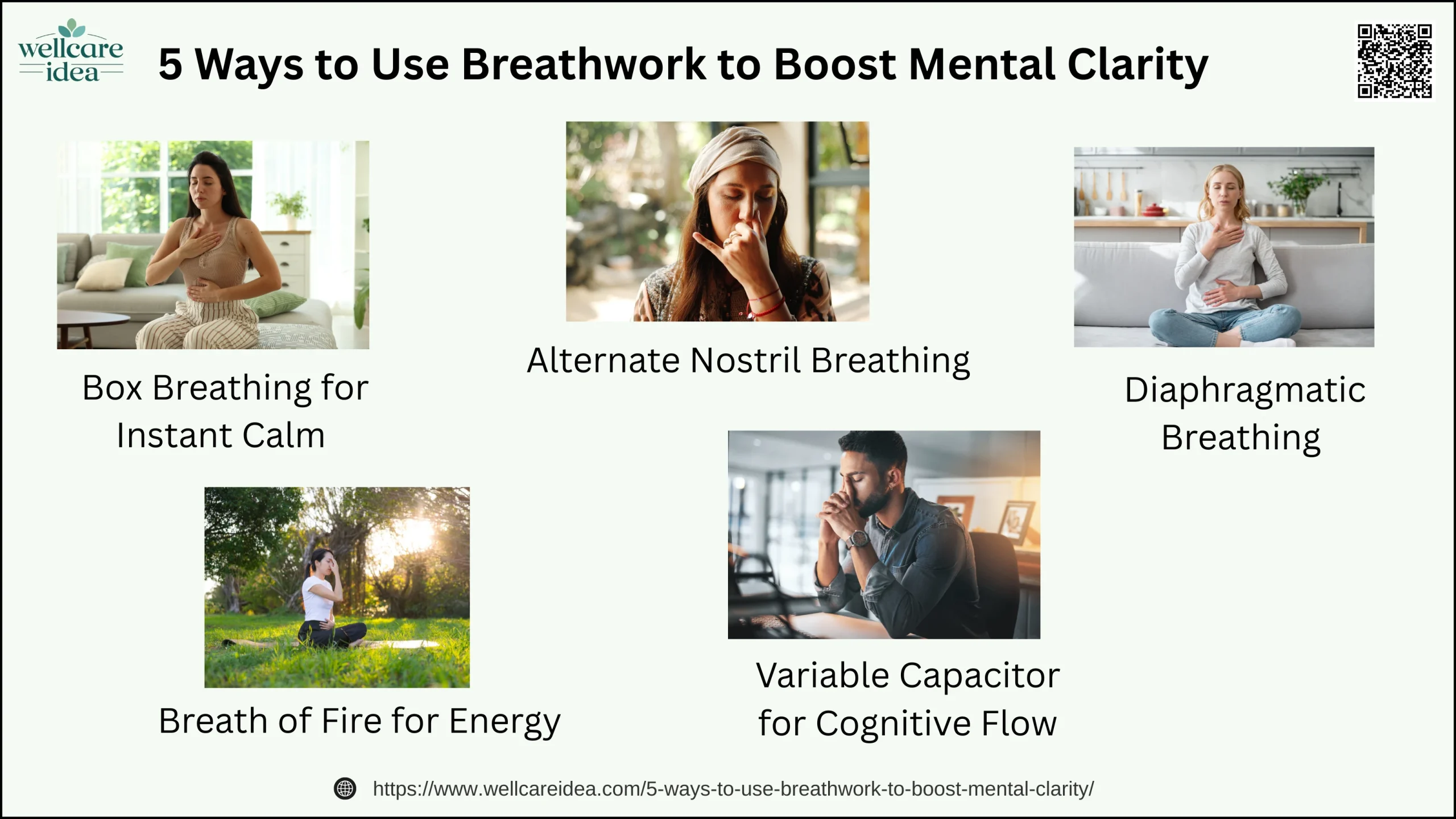
When you need to quickly reset your mind during a stressful day, Box Breathing is an excellent portable technique. Also known as four-square breathing, its structured nature makes it highly effective for interrupting the cycle of stress and sharpening your attention, which is why it is often used by military personnel, athletes, and first responders to maintain composure under pressure. The method involves a simple, equal-part pattern that is easy to remember and practice. To begin, find a comfortable seated position with your back straight. Step one is to gently exhale all the air from your lungs. Step two is to inhale slowly through your nose for a count of four. Step three is to hold your breath at the top of the inhalation for a count of four. Step four is to exhale smoothly through your nose or mouth for a count of four. Finally, step five is to hold the emptiness at the bottom of the exhale for another count of four before repeating the cycle. This symmetrical pattern helps to regulate the nervous system, reduce psychological stress, and bring your focus entirely to the present moment, making it ideal for use before important meetings, study sessions, or any task requiring calm decision-making 6
2. Alternate Nostril Breathing (Nadi Shodhana) for Mental Balance
For those seeking mental equilibrium and emotional calm, Alternate Nostril Breathing, known in yoga as Nadi Shodhana, is a time-tested technique. This practice is believed to balance the left and right hemispheres of the brain, leading to a state of integrated mental clarity and reduced anxiety 7 The physical process of alternating the breath through each nostril is thought to synchronize brain activity and calm the mind. To practice, sit comfortably with a straight spine. Begin by using your right thumb to close your right nostril and inhale gently through your left nostril. At the top of the inhalation, use your right ring finger to close your left nostril, then open and exhale slowly through the right nostril. Next, inhale through the same right nostril, close it again, then open and exhale through the left nostril. This completes one round. The benefits of this practice include enhanced emotional regulation, improved cognitive performance, and a sense of mental balance, making it perfect for a midday reset or as a preparation for deep work.
3. Diaphragmatic Breathing to Improve Brain Oxygenation
Many people fall into the habit of shallow “chest breathing,” especially when stressed, which can perpetuate feelings of anxiety and hamper focus. Diaphragmatic breathing, or “belly breathing,” counteracts this by engaging the diaphragm, the large muscle located beneath the lungs, to support full, efficient oxygen exchange 8 This type of breathing is a foundational practice for many other advanced techniques and is crucial for sustaining concentration. To practice, lie on your back or sit comfortably, placing one hand on your chest and the other on your belly. As you inhale slowly through your nose, focus on allowing your belly to rise, while the hand on your chest remains relatively still. Then, as you exhale through your mouth or nose, feel your belly fall. This deep breathing supports the body’s “rest-and-digest” response, actively calming the nervous system 3 By improving oxygenation and promoting a calmer physiological state, it provides a solid foundation for sustained mental clarity. It is an ideal practice to use anytime you notice your breathing has become shallow, or as a daily routine to build resilience against stress 9
4. Breath of Fire for Energy and Mental Sharpness
When mental fog sets in and you need a quick burst of energy and alertness, the Breath of Fire (Kapalabhati) can be highly effective. This invigorating yogic technique involves short, powerful exhalations and passive inhalations. It is known to boost alertness, clear brain fog, and increase motivation by stimulating the sympathetic nervous system and increasing oxygen circulation 10 To practice, sit comfortably with a straight spine. Take a normal inhale, then on the exhale, sharply contract your abdominal muscles to push the air out through your nose. The inhalation that follows should be a passive, automatic rebound as you release the abdominal contraction. The focus is entirely on the active exhalation, with a rate of about one exhale per second to start. For beginners, it is crucial to start with short sessions of 30 seconds to one minute and to build up gradually. Avoid this technique if you are pregnant, have high blood pressure, or have any cardiac or respiratory conditions. When performed correctly, Breath of Fire can serve as a powerful, natural stimulant to refresh the mind.
5. Resonant Breathing (Coherent Breathing) for Cognitive Flow
For enhancing creativity and entering a state of cognitive flow, Resonant or Coherent Breathing is a powerful, scientifically-supported method. This technique involves breathing at a very specific, slow rate of approximately 5.5 breaths per minute, which translates to an inhalation for 5.5 seconds and an exhalation for 5.5 seconds 11 This particular rhythm has been identified as the “resonance frequency” for the human cardiovascular system, meaning it optimally synchronizes your heart rate, blood pressure, and respiratory rhythms 4 This synchronization, a state known as physiological coherence, maximizes Heart Rate Variability (HRV), a key indicator of your body’s ability to manage stress and maintain resilience. The even duration of the inhale and exhale is crucial for achieving this balance, as it sends consistent, calming signals to the autonomic nervous system 11 Research involving chanting and prayer across different cultures, including Buddhist, Christian, and Hindu traditions, has found they naturally occur at this same rhythmic frequency of about 5.5 breaths per minute, suggesting an intuitive human understanding of its calming effects. To practice, simply inhale through your nose for 5.5 seconds and exhale through your nose or mouth for 5.5 seconds, using a timer or app for guidance. Regular practice can lead to profound calm, sharpened focus, and enhanced problem-solving abilities 4
How to Make Breathwork a Daily Habit
Integrating breathwork into your daily life is essential for experiencing its long-term benefits for mental clarity. The key to building a sustainable practice is consistency, not duration. Begin with very short sessions of just one to five minutes to ensure the habit does not feel overwhelming. A highly effective strategy is to pair your breathwork practice with an existing habit, a method known as “habit stacking.” For example, you could practice one minute of diaphragmatic breathing upon waking, use Box Breathing before starting your work computer, or employ a few rounds of Alternate Nostril Breathing during your afternoon slump. Many people find that a morning session sets a calm, focused tone for the day, while a brief mid-day session serves as an effective reset 12 To maintain motivation, you might track your practice in a journal or app, noting small improvements in your focus, productivity, and emotional reactivity over time.
Conclusion
The breath presents a powerful, portable, and free tool for managing our mental state and cutting through the fog of cognitive overload. From the structured calm of Box Breathing and the balancing effect of Alternate Nostril Breathing to the foundational power of Diaphragmatic Breathing, the energizing blast of Breath of Fire, and the scientifically-grounded synchronization of Resonant Breathing, these five methods offer a practical toolkit for anyone seeking to enhance their mental clarity. By consciously working with the breath, we can directly influence our nervous system, reduce stress hormones, and create the optimal internal conditions for focus, creativity, and clear thinking. We encourage you to explore these techniques and discover which ones work best for you, remembering that a daily practice, no matter how brief, is the most effective path to lasting benefits 1