
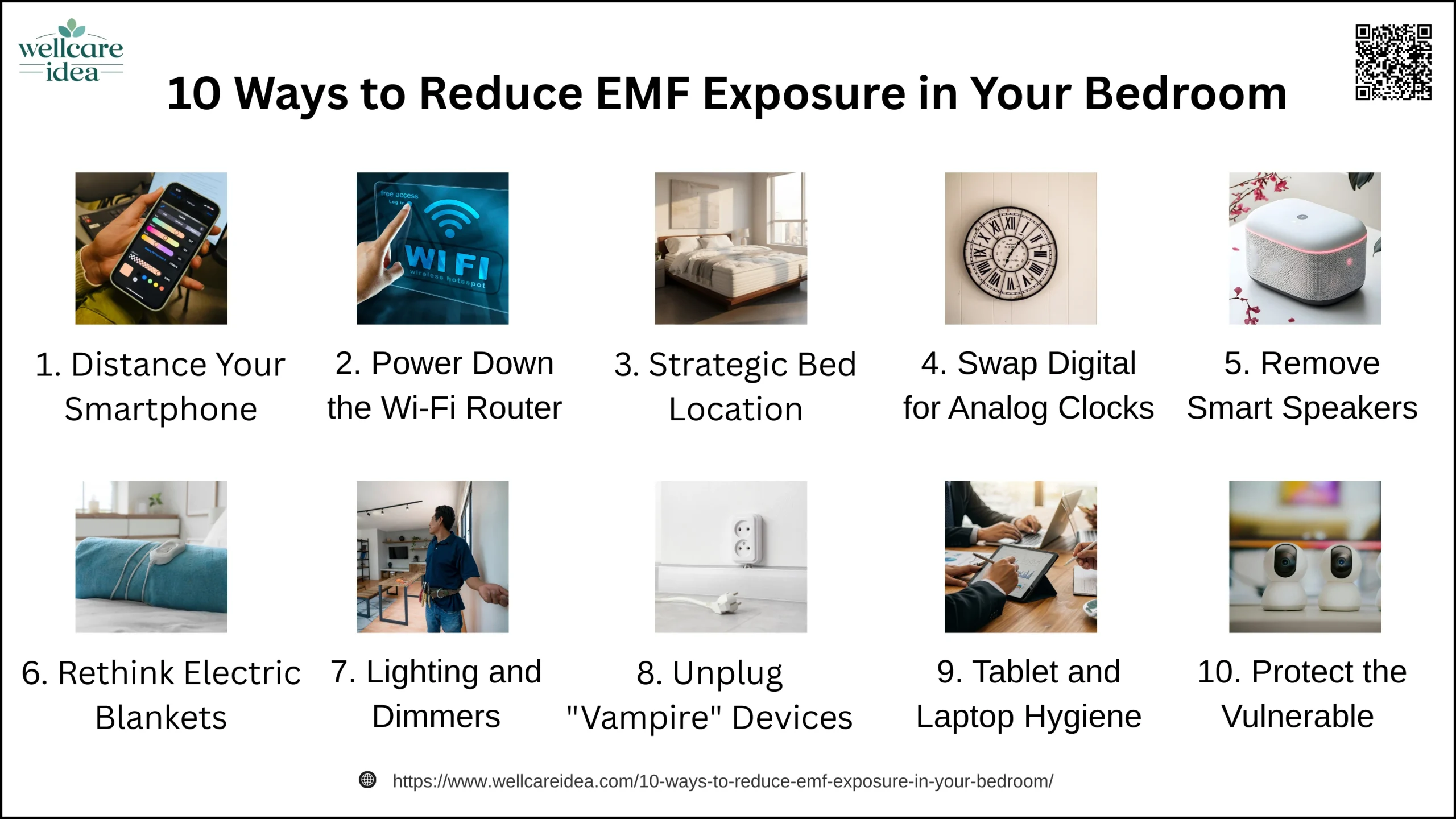
We often think of our bedrooms as safe havens, a place to disconnect from the stress of the day. However, in our modern world, we are surrounded by invisible lines of energy known as Electromagnetic Fields (EMFs). These fields are emitted by everything from our smartphones and Wi-Fi routers to the wiring inside our walls. While the scientific community continues to study the long-term effects of cumulative exposure, many experts agree that reducing our daily load—particularly where we sleep—is a prudent approach to wellness.
Sleep is biologically critical; it is the time when your body enters a repair mode, clearing metabolic waste and regenerating cells. Some research suggests that exposure to certain types of electromagnetic radiation may interfere with this process by suppressing the production of melatonin, the hormone that regulates sleep-wake cycles. By creating a “low-EMF” sleep sanctuary, you allow your body to rest without the constant interference of digital signals.
The “Big Three” Sources
To make the biggest impact with the least amount of effort, start with these three primary sources of EMF radiation found in almost every bedroom.
1. Distance Your Smartphone
The most common source of radiofrequency (RF) radiation is the device we hold closest to us: the smartphone. Many people sleep with their phones on their nightstands or even under their pillows. This keeps a device that is constantly transmitting and receiving data right next to your head. The intensity of radiation drops significantly as you move away from the source. To minimize exposure, the best practice is to remove the phone from the bedroom entirely. If you must keep it nearby for emergencies, enable “Airplane Mode,” which cuts off cellular, Wi-Fi, and Bluetooth signals. Reference: See research on RF exposure and proximity at the National Institutes of Health (NIH) 1
2. Power Down the Wi-Fi Router
Your Wi-Fi router is essentially a mini radio tower, pulsing signals through your home 24/7. While convenient during the day, this constant signaling is unnecessary while you sleep. Turning your router off at night creates a period of “digital silence” that drastically lowers the RF density in your home. If manually unplugging it is a hassle, you can install a simple mechanical outlet timer to automatically cut the power to the router at your bedtime and turn it back on before you wake up. Reference: Studies on the environmental effects of Wi-Fi signals can be found on ScienceDirect 2
3. Strategic Bed Location
EMFs are not just wireless signals; they also come from the electrical wiring in your walls. Magnetic fields can be particularly high near electrical panels or utility meters (like smart meters). If your bed is positioned against a wall that houses the main circuit breaker panel or an electric meter on the outside, you may be sleeping in a high magnetic field zone. Moving your bed to the opposite side of the room, or at least a few feet away from that specific wall, can significantly reduce your exposure. Reference: Information on magnetic fields and home wiring is available from the National Institute of Environmental Health Sciences (NIEHS) 3
Managing Electronics & Appliances
Once you have handled the major sources, look at the everyday items in your room that might be contributing to “electrosmog.”
4. Swap Digital for Analog Clocks
Standard digital alarm clocks plugged into the wall can generate surprisingly high electric fields right at the level of your head. This is due to the alternating current (AC) electricity flowing constantly to the device. A simple, low-tech solution is to swap your plug-in clock for a battery-operated one. Battery-powered devices use direct current (DC), which does not produce the same type of oscillating electric field.
5. Remove Smart Speakers
Smart assistants and voice-activated speakers are convenient, but they are also devices that maintain a constant connection to your network. Like your phone or router, they emit RF signals to stay connected to the internet and other devices. For a cleaner sleep environment, it is best to keep these devices in common areas like the kitchen or living room rather than on your bedside table.
6. Rethink Electric Blankets
Electric blankets might keep you warm, but they envelop your body in a grid of electrical wires, creating a magnetic field directly against your skin and internal organs for eight hours a night. Some epidemiological studies have investigated potential links between this proximity and various health issues. A safer alternative is to use the electric blanket to pre-heat the bed, then unplug it completely (don’t just turn it off) before you get in to sleep. Reference: Historical data on electric blankets and magnetic field exposure is archived at PubMed (NIH)
7. Lighting and Dimmers
Light is a form of electromagnetic frequency. Blue light, specifically, mimics daylight and signals the brain to wake up, suppressing melatonin. Furthermore, dimmer switches often “chop” the electrical current to dim the light, which can create “dirty electricity”—spikes in electromagnetic energy that radiate from the wiring. Using standard on/off switches and amber or red-hued bulbs in the bedroom can support your natural circadian rhythms. Reference: Read about the effects of blue light on melatonin at Harvard University 4
Habits & Maintenance
Finally, adjusting a few daily habits can further lower the EMF load in your bedroom.
8. Unplug “Vampire” Devices
Many electronic devices continue to draw power and create electric fields even when they are turned off, provided they are plugged in. This includes lamps, phone chargers, and televisions. By unplugging these items when not in use, or using a power strip that you can switch off, you eliminate these ambient electric fields near your sleeping area.
9. Tablet and Laptop Hygiene
It is common to read on a tablet or watch a movie on a laptop while in bed. However, placing these devices directly on your lap or chest exposes vital organs to heat and RF radiation. If you use a tablet to read, download your book or article first, then switch the device to “Airplane Mode.” Avoid charging laptops or tablets near the bed while you are sleeping. Reference: Research regarding laptop heat and RF exposure on biological tissues can be found on ResearchGate. 5
10. Protect the Vulnerable (Baby Monitors)
Children are more susceptible to environmental stressors than adults because their skulls are thinner and their nervous systems are still developing. Wireless baby monitors constantly transmit RF signals, often placed directly next to the crib. To reduce this risk, choose a hard-wired monitor (which sends signals through wires rather than the air) or place wireless monitors at least 6 to 10 feet away from the crib. Reference: Scientific reviews on children’s absorption of RF radiation are published in PubMed https://pubmed.ncbi.nlm.nih.gov/21929340/}
Conclusion
Reducing EMF exposure in your bedroom does not require living by candlelight or abandoning technology. It is about distance and duration. By creating a sleeping environment with fewer active signals—simply by moving your phone, turning off the Wi-Fi, and unplugging unnecessary devices—you reduce the burden on your body during its most critical recovery period. You don’t have to be perfect to see benefits; try implementing just one or two of these changes tonight to start building a cleaner, more restful sleep sanctuary.